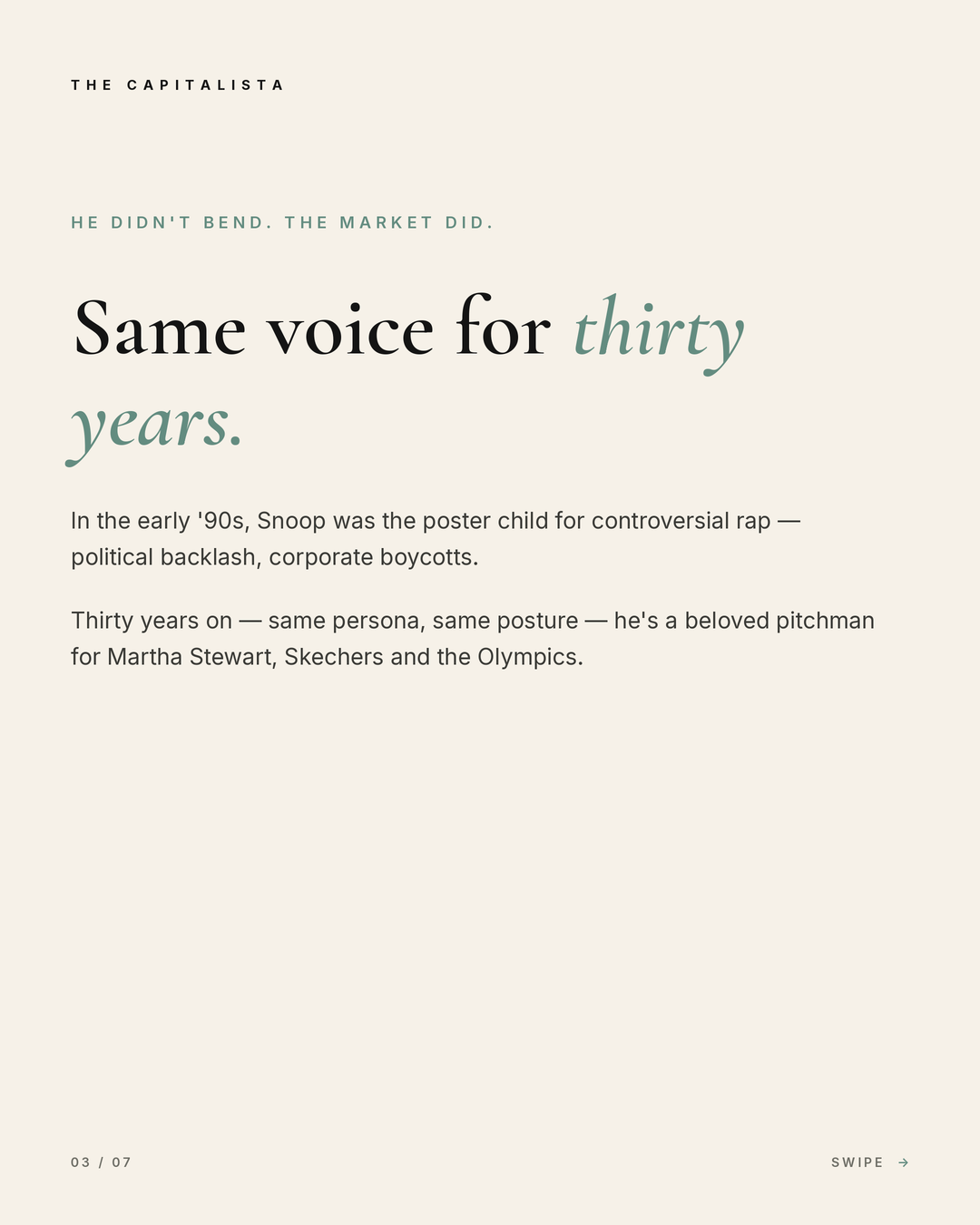
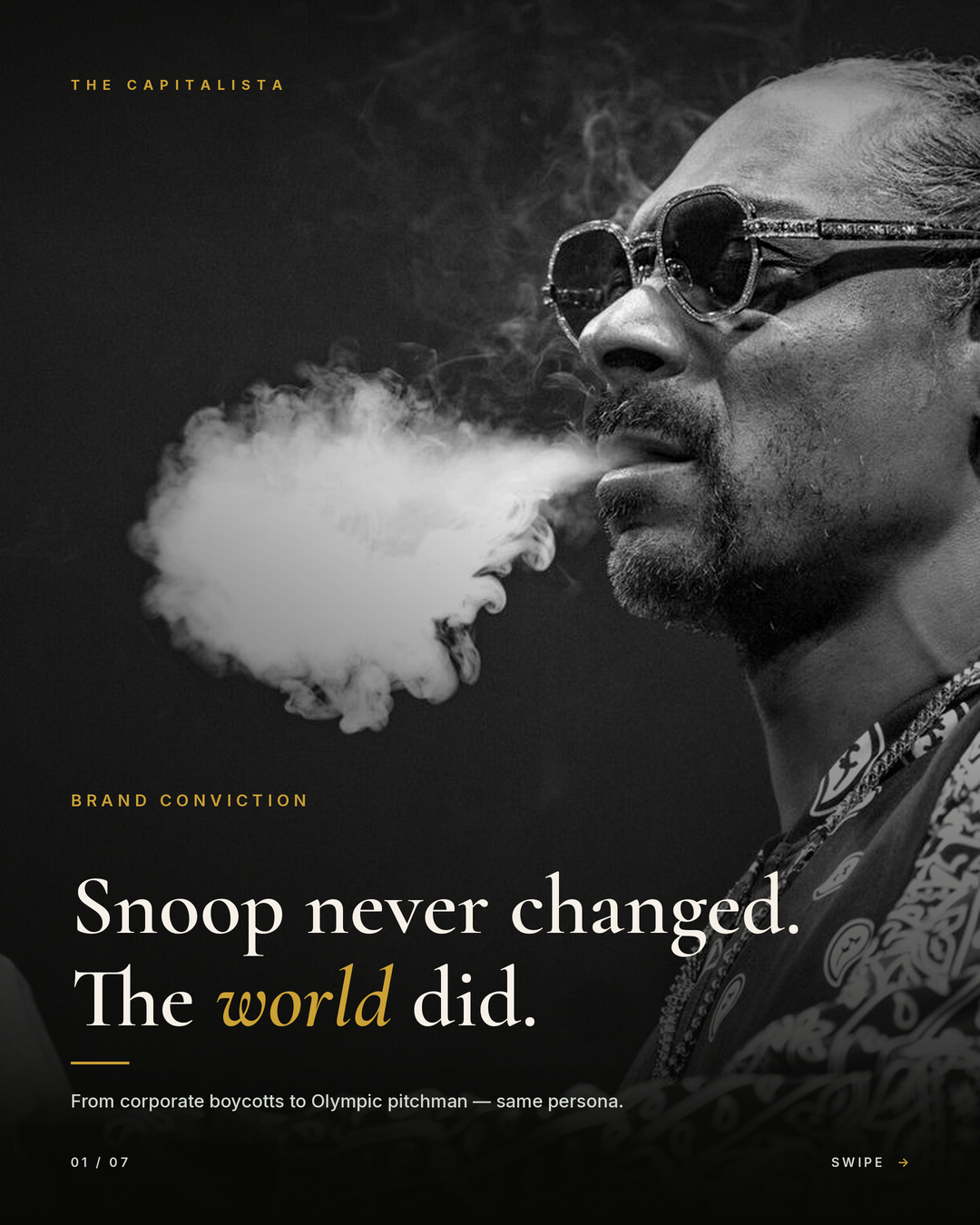
In the early 1990s, Snoop Dogg was one of the most boycotted names in American culture.
He was the face of a music genre that corporations wouldn't touch, the subject of political campaigns, congressional hearings, and advertiser pressure. Three decades later, nothing about him has fundamentally changed — and that is precisely the point.
Same voice. Same posture. Same persona. Yet today Snoop is a beloved global pitchman for Martha Stewart, Skechers, and the Olympic Games. Fortune 500 companies now pay a premium to borrow the exact identity the establishment once tried to cancel.
He didn't bend to fit the corporate world. The corporate world recalibrated to him.
For founders, operators, and anyone building a brand, this is one of the most valuable and counterintuitive lessons in modern positioning: the market rewards consistency over compliance. Below, we break down why diluting your perspective quietly destroys your pricing power — and how holding a clear, even polarizing, position is a long-term financial strategy, not just a creative one.
The hidden cost of "professional" blandness
Most founders don't lose their edge in a single dramatic moment. They lose it in increments.
A sharp opinion gets softened before a sales call. A bold landing-page headline gets watered down so it won't "alienate" anyone. A distinctive point of view about the industry gets quietly shelved because a board member, a partner, or an imagined critic might disapprove. Each individual edit feels reasonable. Each one trims a little risk.
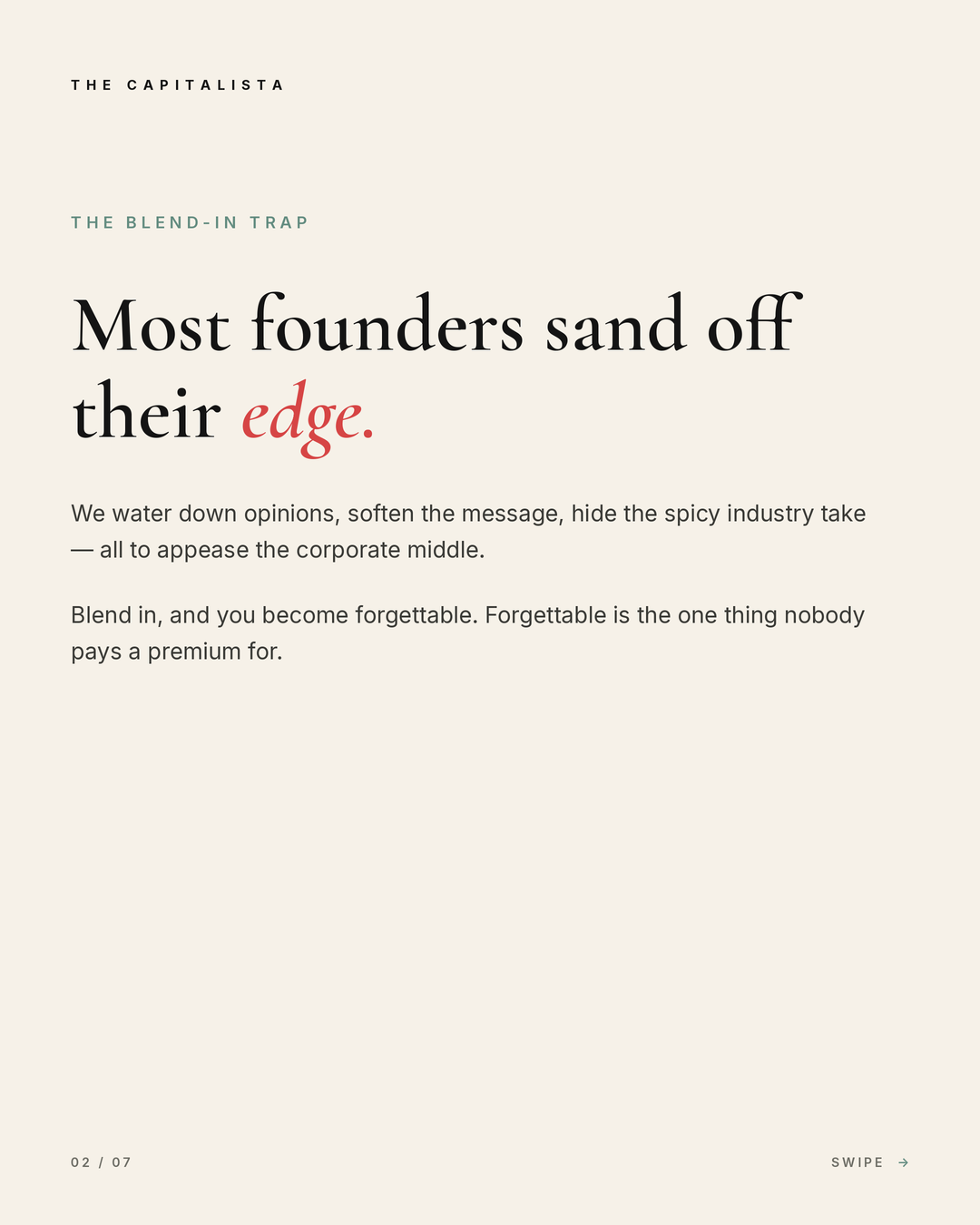
The cumulative effect is brand erosion. You optimize toward the inoffensive middle, where every competitor already lives, and you arrive at the one outcome no business can afford: you become forgettable.
Forgettable is expensive. Forgettable companies compete on price because they've given the buyer no other reason to choose them. When your positioning is indistinguishable from five alternatives, the conversation collapses to a single variable — cost — and your margin goes with it. Differentiation is what lets you charge a premium; sameness is what forces you to discount.
This is the core trap. Founders sanitize their messaging to feel safer, not realizing that blandness is itself a financial risk. The pursuit of universal approval is a direct route to commoditization.
Why consistency compounds (and compliance doesn't)
Snoop's value didn't come from changing to suit the market. It came from being so unwavering for so long that his identity became a fixed point everyone else could navigate by.
That's the mechanism worth understanding. A consistent brand is a compounding asset. Every year you hold the same clear position, you add another layer of credibility, recognition, and trust. The market learns exactly what you stand for. Your name starts to mean something specific — and specificity is what people pay for.
Compliance, by contrast, resets the clock. Every time you shift your message to match the prevailing mood, you erase the equity you were building and ask your audience to relearn who you are. You trade a durable, appreciating asset for temporary, superficial approval.
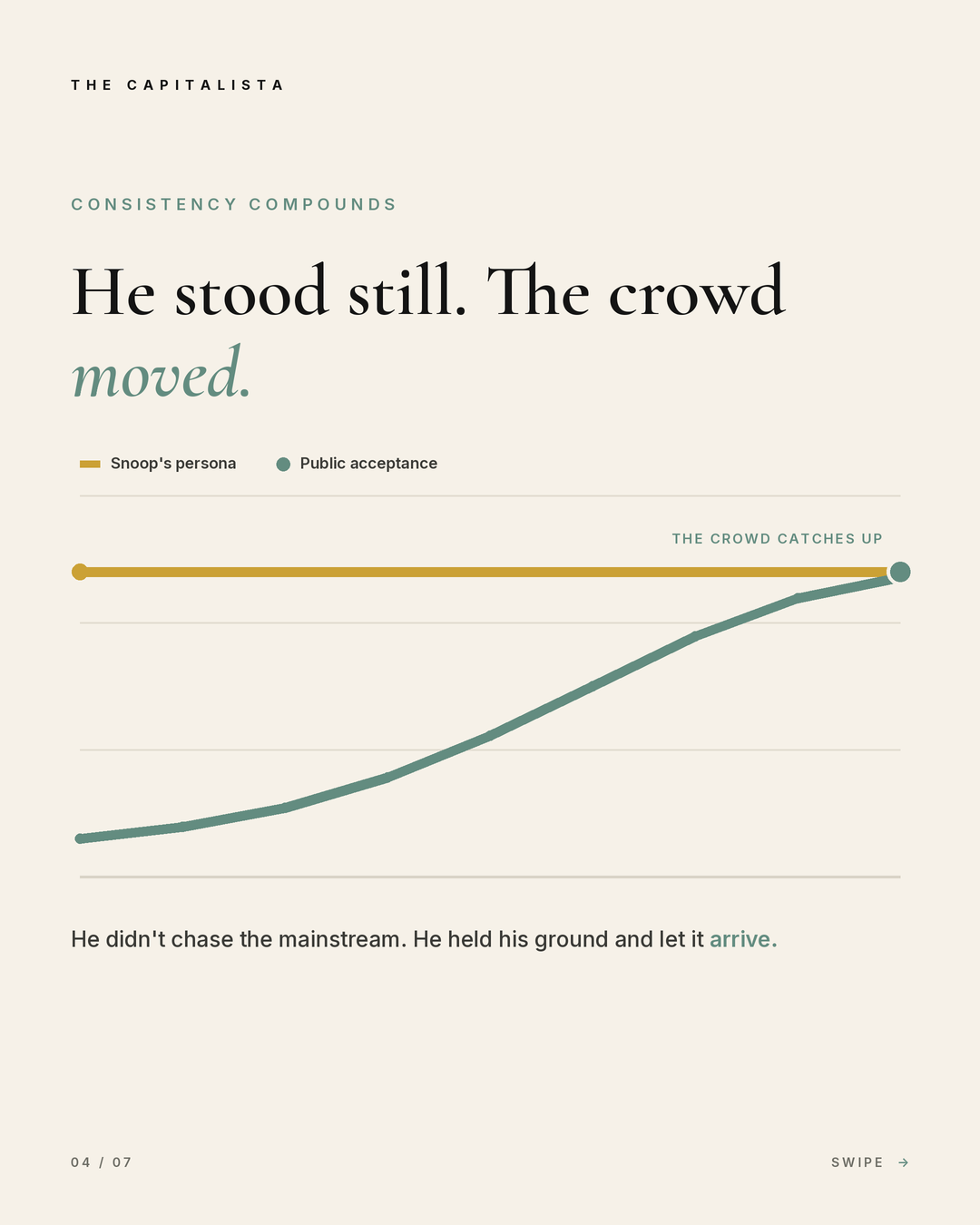
Think of it as two lines on a chart. One is your conviction: flat, steady, unmoved over time. The other is public acceptance: it starts low, sometimes hostile, then climbs. If you hold your line, the second line eventually rises to meet it. If you keep moving your line to chase the second one, the two never converge — you're always reacting, never anchoring.
The founders who win the long game don't chase the mainstream. They hold their ground and let the mainstream arrive.
Conviction is a positioning strategy, not a personality trait
It's tempting to read the Snoop example as a story about confidence or charisma. It isn't. It's a story about strategic positioning, and it's reproducible without a famous persona.
Conviction in branding means three concrete things:
A clear point of view. You take a definable stance on how your industry should work, what most competitors get wrong, or what your customers should stop tolerating. A point of view is inherently a little polarizing — it has to be, or it isn't a point of view. The goal is not to offend; the goal is to be unmistakable to the people you're actually for.
Message discipline over time. You repeat your core positioning until it becomes boring to you. The moment a founder is sick of their own message is usually the moment the market is just beginning to absorb it. Consistency feels repetitive from the inside and feels like clarity from the outside.
Comfort with self-selection. A strong position repels the wrong customers as efficiently as it attracts the right ones. That repulsion is a feature. The clients who don't fit your worldview are the ones who haggle hardest, churn fastest, and respect you least. Letting them filter themselves out is how you build a book of business that values you.
None of this requires being controversial for its own sake. It requires being legible — having a position so clear that a stranger could describe what you stand for after a single encounter.
How to audit your brand for "compliance creep"
If you suspect your messaging has drifted toward the safe middle, here's how to diagnose and reverse it.
Find the stance you softened. Look back at your positioning, your sales decks, your website, and your content. Identify one strong opinion you used to hold publicly and quietly retired out of fear of making waves. That retired stance is often your most valuable differentiator — you abandoned it precisely because it was distinctive enough to provoke a reaction.
Test for memorability, not agreement. The wrong question is "Will everyone agree with this?" The right question is "Will the right person remember this?" Agreement is the metric of the forgettable. Memorability is the metric of the premium.
Check your discounting patterns. Frequent pressure to lower your price is rarely a pricing problem; it's usually a positioning problem. When buyers can't articulate why you're different, they default to negotiating on cost. If you're discounting often, your message has probably blurred.
Re-inject one bold, polarizing position. Don't overhaul everything at once. Choose a single, defensible stance and put it back at the center of your messaging. Say the thing you believe about your industry that your competitors are too cautious to say. Then hold it — through the discomfort, through the pushback, long enough for the compounding to begin.
Consistency is a financial decision
It's easy to file brand conviction under "marketing" and move on. That's a mistake. Positioning is one of the highest-leverage financial decisions a business makes, because it sets the ceiling on what you're allowed to charge.
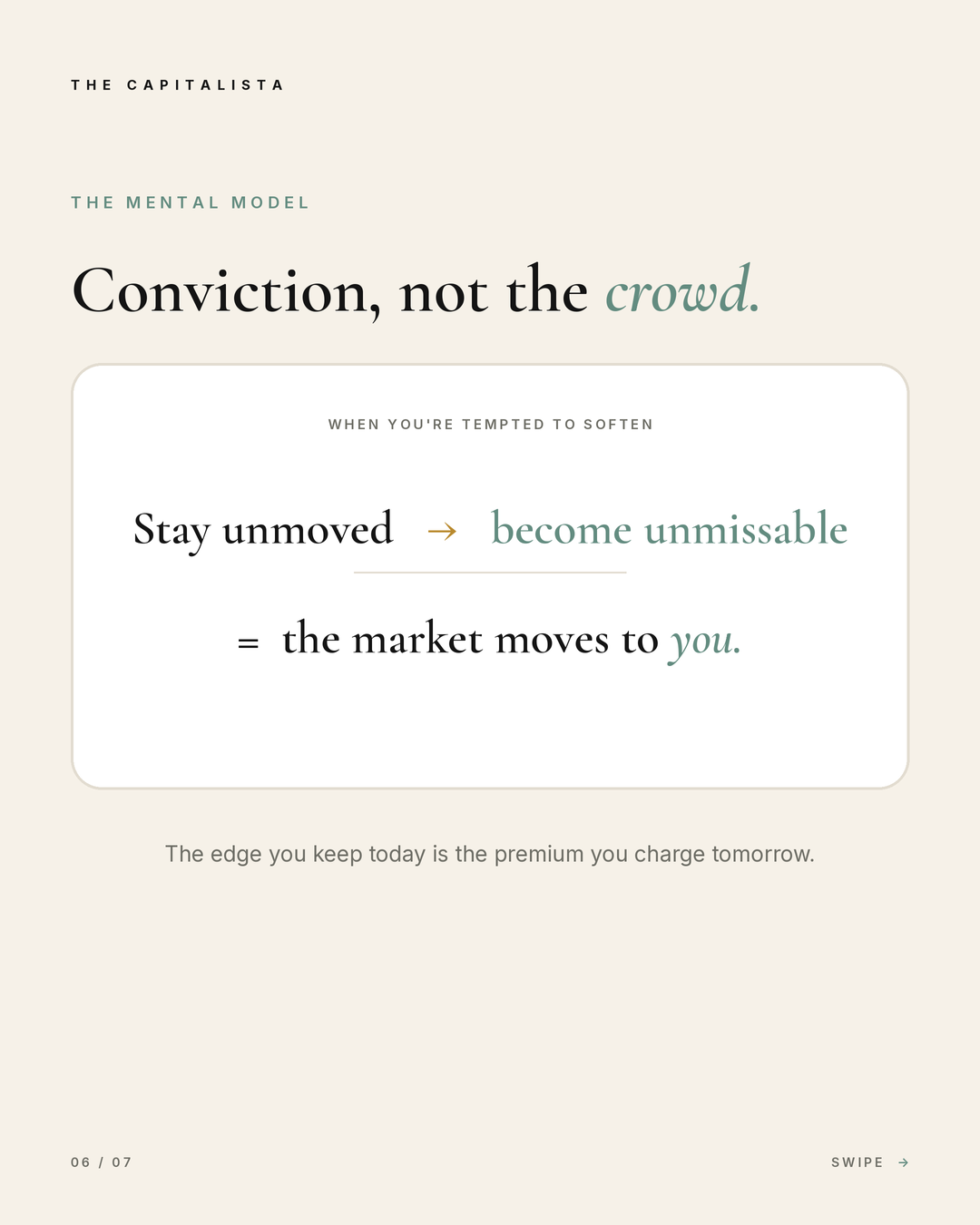
A diluted, compliant brand competes in a crowded commodity market and absorbs constant margin pressure. A consistent, conviction-led brand becomes a category of one — and a category of one sets its own prices. The edge you protect today is the premium you command tomorrow.
Snoop Dogg never changed to be accepted by the corporate world. He stayed exactly who he was until being exactly who he was became the most valuable thing about him. The brands that pay him aren't buying a softened, focus-grouped version of the artist. They're paying for the conviction itself.
Your business can operate on the same principle. Stop sanding off your edge to appease the middle. Hold your position with discipline, let the right audience self-select toward you, and give the market time to reprice you accordingly.
Frequently asked questions
What does "consistency over compliance" mean in branding? It means staying true to a clear, distinctive brand position over time rather than constantly adjusting your message to win broad approval. Consistency builds compounding equity and pricing power; compliance trades that equity for temporary, superficial acceptance.
Doesn't a polarizing brand position lose customers? It loses the wrong customers — the price-sensitive, poorly-fit buyers who were never going to value you. A clear position attracts the right customers more strongly than it repels others, and those right customers are the ones who pay a premium and stay.
How is brand consistency connected to pricing power? Differentiation is what allows premium pricing. When your brand is indistinguishable from competitors, buyers negotiate on cost and your margins compress. A consistent, conviction-led position makes you a category of one, which lets you set prices rather than defend them.
How do I find the position I've over-softened? Review old decks, web copy, and content for a strong opinion you quietly stopped voicing. The stance you abandoned out of fear of "making waves" is frequently your sharpest differentiator. Re-inject it deliberately and hold it consistently.