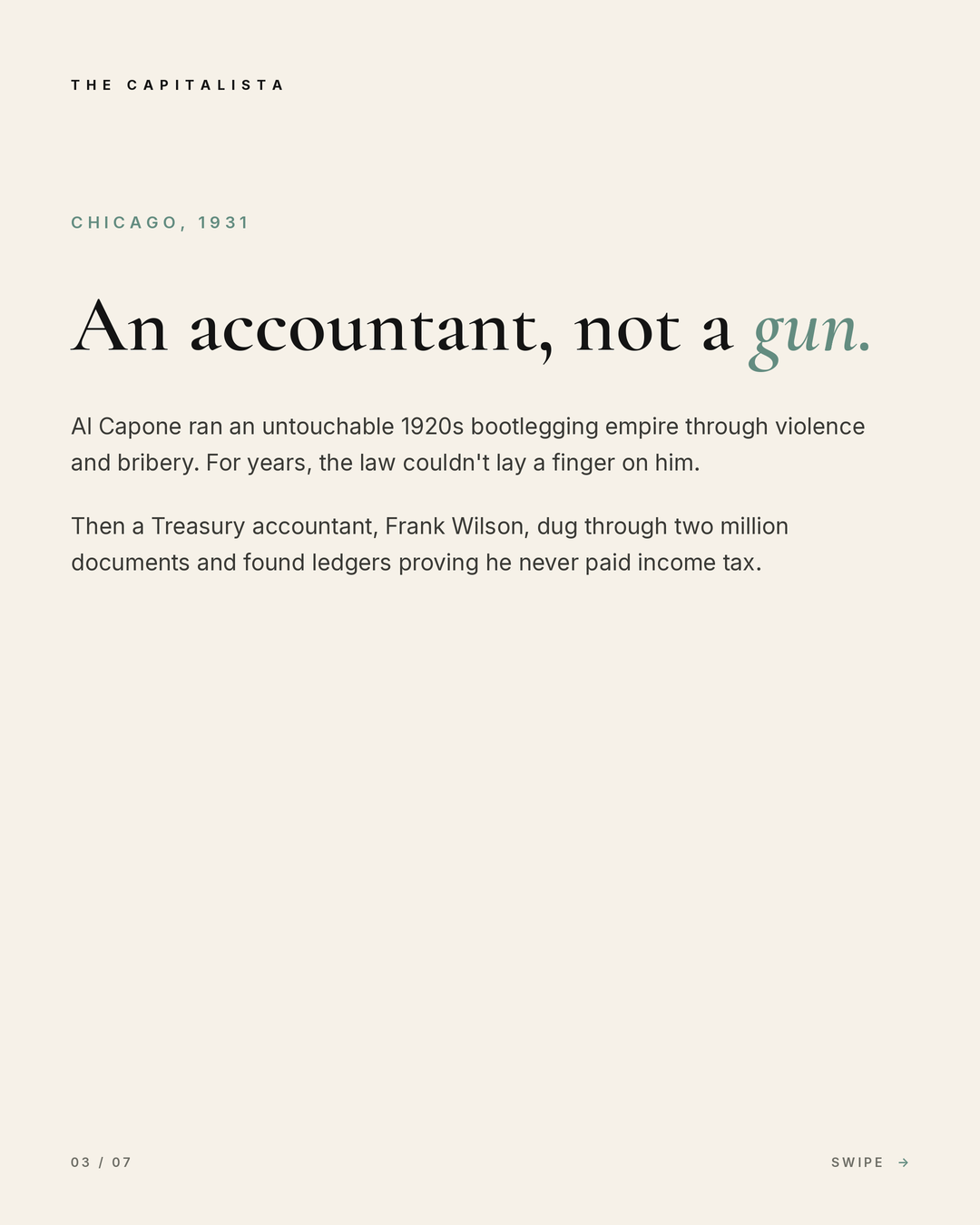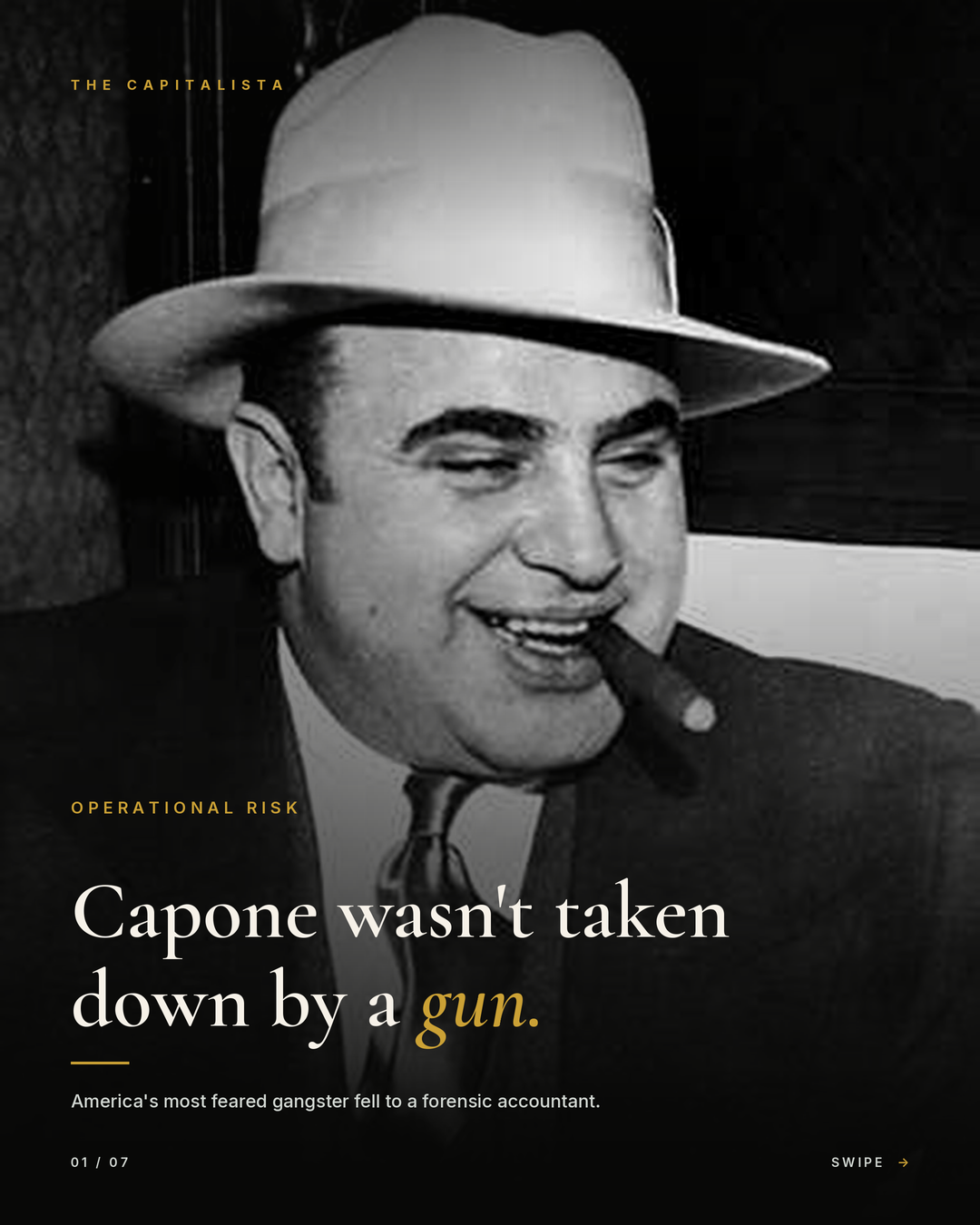
Al Capone was, for years, untouchable. As the most feared crime boss of 1920s America, he ran a sprawling bootlegging empire through violence, intimidation, and widespread political bribery.
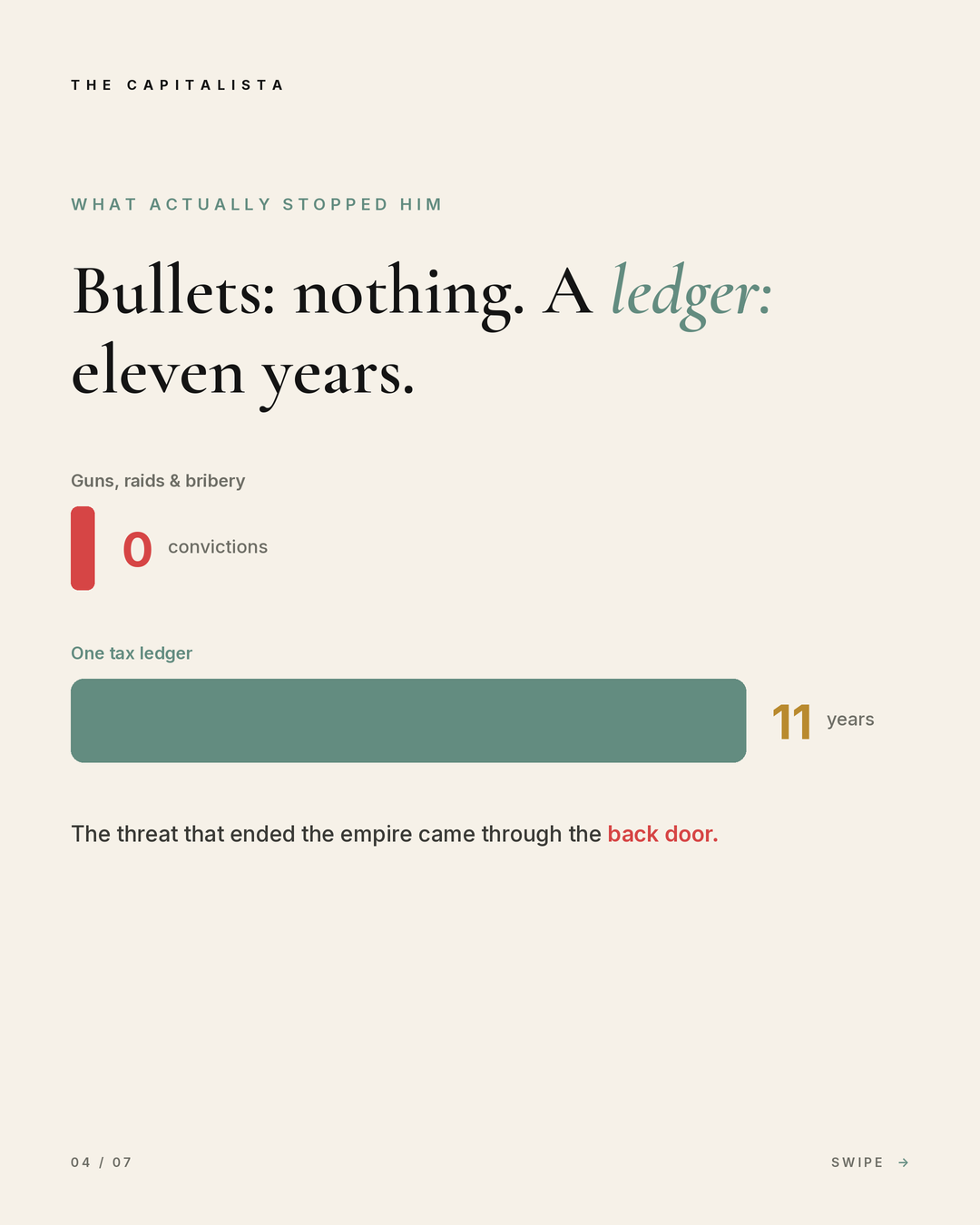
Federal and local law enforcement threw everything they had at his front-facing operations — raids, informants, surveillance, the occasional shootout — and none of it stuck. On paper, he was invincible.
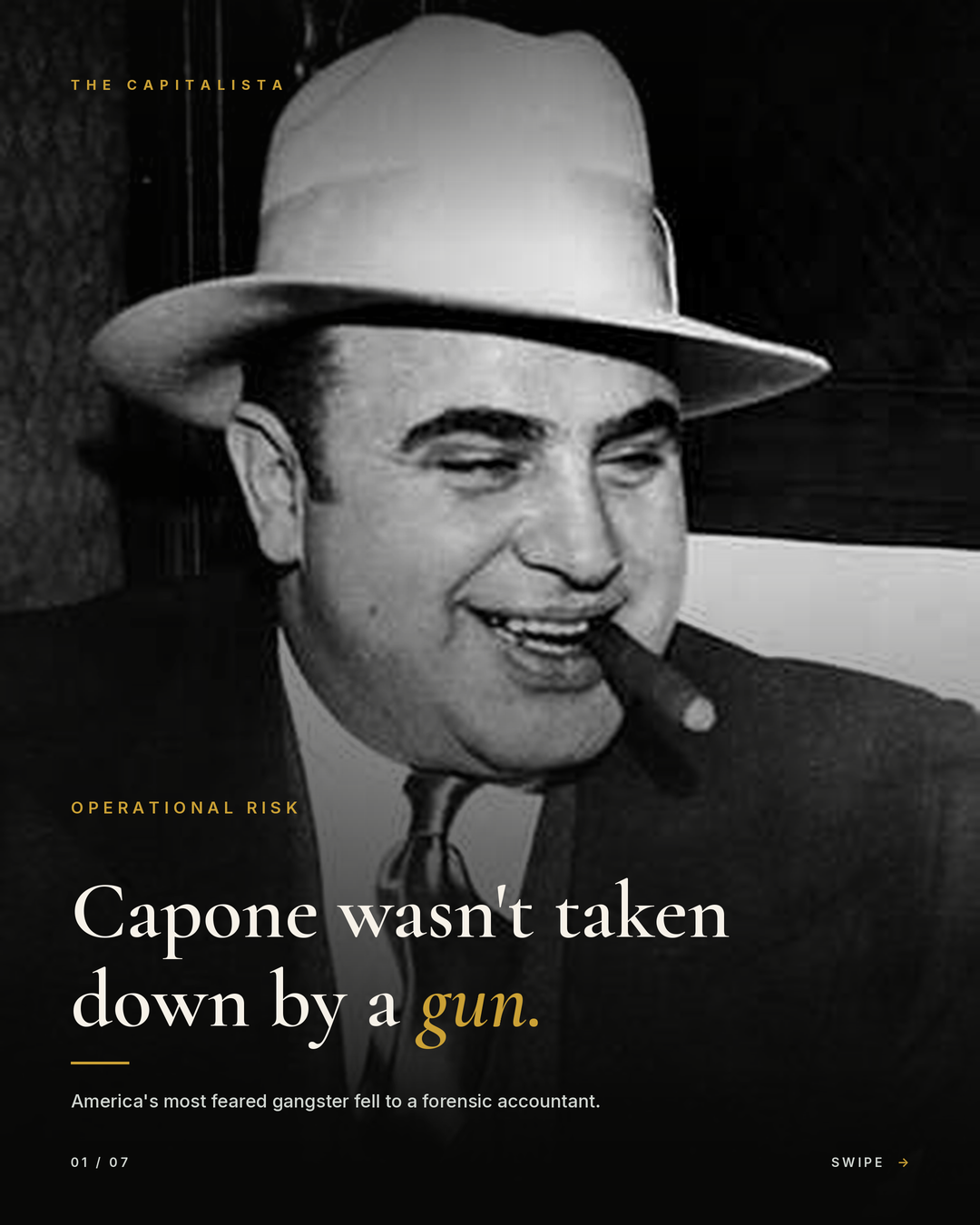
His empire wasn't brought down by a rival gang or a dramatic street-corner gunfight. It was dismantled by an invisible, entirely unglamorous backdoor. A dedicated Treasury investigator named Frank Wilson quietly worked through roughly two million documents and found the ledgers that proved Capone had never paid income tax on his illegal earnings. In 1931, the untouchable gangster was convicted of tax evasion and sentenced to 11 years in prison.
The empire that survived every external assault was destroyed by a boring financial ledger.
For founders and operators, this is one of the most important — and most ignored — lessons in business. Your greatest operational risk is rarely a smarter competitor trying to out-market you. It's your own neglected backend: the tax, legal, and compliance infrastructure quietly holding up everything you've built.
The obvious enemy versus the real one
Every operator has a mental image of the threat to their business, and it's almost always external and visible: the competitor with the better product, the rival undercutting your prices, the new entrant stealing your market share. That's the enemy you can see, so that's the enemy you fight. You pour your energy into out-marketing, out-selling, and out-hustling the other players in your arena.
Meanwhile, the threat that actually takes companies down is usually internal, silent, and boring. It doesn't announce itself. It sits at the back of the business, in the systems nobody enjoys thinking about — the bookkeeping, the contracts, the corporate structure, the regulatory filings, the tax framework.
Capone's downfall is the perfect metaphor because the mismatch was so total. He was defended against every obvious front-facing attack and completely exposed at the back. The law stopped trying to beat him at his own game — violence — and simply walked through the unlocked door of his finances.
Most businesses are structured exactly the same way: heavily fortified against visible competition, wide open at the back. The founder is watching the front gate while the real risk walks in through accounting.
Why backend neglect is so dangerous
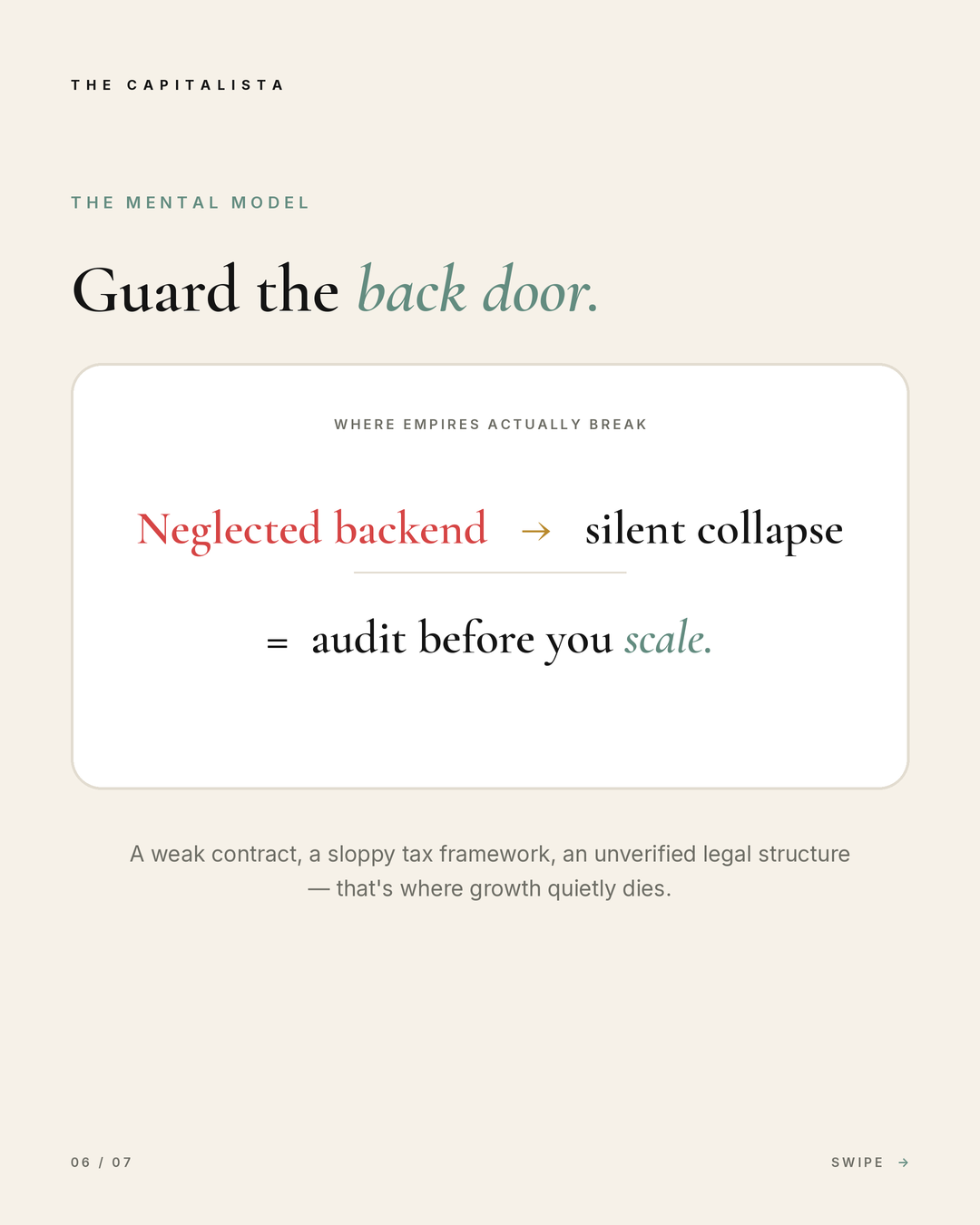
The reason backend risk is so lethal is precisely that it's invisible until it isn't. A neglected compliance issue produces no obvious symptoms in the metrics founders actually watch. Your sales dashboard looks healthy. Revenue is up. Growth feels real. Nothing on the front end tells you that a weak contract, a sloppy tax setup, or an unverified legal structure is quietly compounding into an existential problem.
This is what makes it a silent, parasitic threat. It drains and endangers the business from the inside while every front-facing indicator says everything is fine. By the time it surfaces — an audit, a lawsuit, a regulatory penalty, a contract dispute — it's no longer a small administrative fix. It's a crisis, and often an expensive or fatal one.
A single weak point in your infrastructure can undo years of front-end success:
A sloppy tax framework can turn profitable years into liabilities, penalties, and, in the extreme, criminal exposure — the exact trap that ended Capone.
A weak or ambiguous contract can hand away your intellectual property, expose you to disputes, or collapse a key relationship precisely when it matters most.
An unverified legal structure can eliminate the liability protection you assumed you had, putting personal assets at risk.
Neglected bookkeeping hides the true state of the business and makes every one of the above problems harder to see coming.
None of these show up when you're staring at your growth chart. All of them can end the company.
The scale trap: growth makes it worse
Founders often assume backend rigor is something to handle "later," once the business is bigger and can afford it. This gets the risk exactly backwards. Scaling doesn't reduce backend exposure — it multiplies it.
Every new client contract signed on weak terms replicates the same flaw across your entire book. Every dollar of additional revenue run through a sloppy tax framework increases the eventual liability. Every layer of growth stacked on an unverified legal structure raises the stakes of it failing. Growth doesn't outrun a backend problem; it scales it in lockstep.
This is why the discipline has to come before the scale, not after. The stronger your growth, the more damage a hidden structural weakness can do. You are building a taller and taller tower on a foundation you've never inspected.
How to audit your back door
Defending the backend isn't glamorous, but it's straightforward. It mostly requires deliberately turning your attention away from the metrics you enjoy watching and toward the systems you'd rather ignore. Here's where to start.
Schedule a real compliance audit. Block the time deliberately — the whole point is that this work never feels urgent until it's a catastrophe. Put a comprehensive review of your legal, tax, and operational compliance on the calendar the way you'd schedule anything else that matters.
Review your client contracts. Read the actual terms, not the dollar figures. Check who owns the intellectual property, what your liabilities are, and what happens when a relationship ends. Fix the templated language that's quietly replicated across every deal.
Verify your legal structure. Confirm that your entity actually provides the liability protection you think it does, that it's properly maintained, and that it fits the business you've become — not the one you were when you set it up.
Pressure-test your bookkeeping and tax framework. Make sure your books reflect reality and that your tax approach is clean and defensible. This is the specific door Capone left open; it's the last one you want ajar.
Bring in outside eyes. The whole nature of a blind spot is that you can't see it yourself. An independent advisor or specialist will spot the structural weaknesses you've normalized.
The takeaway: guard the door no one is watching
Al Capone spent his life defending against the threats he could see and never seriously guarded the one he couldn't. Every gun in Chicago couldn't protect him from a diligent accountant with a stack of ledgers, because the fatal weakness was never at the front of his empire. It was in the back office the whole time.
Your business is more like Capone's than you'd like to admit. You are almost certainly well-defended against your visible competitors and under-defended against your own infrastructure. The failure that ends companies rarely comes from the rival you're watching. It comes from the contract you didn't read, the taxes you didn't structure properly, the entity you never verified.
So stop staring at your sales metrics for an hour today. Turn around and inspect the back door — your books, your contracts, your compliance, your legal structure — before someone else does it for you.
Frequently asked questions
What is the biggest risk to most businesses? For most companies, the biggest risk isn't a competitor — it's neglected internal infrastructure: tax, legal, contract, and compliance weaknesses. These are dangerous because they're invisible in day-to-day performance metrics and often surface only once they've become a crisis.
How did an accountant bring down Al Capone? Treasury investigator Frank Wilson examined roughly two million documents and found ledgers proving Capone had unreported income. That evidence led to a tax-evasion conviction in 1931 and an 11-year prison sentence — succeeding where years of law-enforcement pressure on his criminal operations had failed.
Why is backend or compliance risk so hard to catch? Because it produces no visible symptoms in the metrics founders watch. Sales and growth can look excellent while a weak contract, sloppy tax framework, or unverified legal structure compounds silently in the background, only surfacing as an audit, lawsuit, or penalty once it's already serious.
How do I reduce my business's compliance risk? Schedule a deliberate compliance audit, review your client contracts for ownership and liability terms, verify that your legal structure actually protects you, keep your bookkeeping and tax framework clean, and bring in an independent expert to catch the blind spots you can't see yourself.