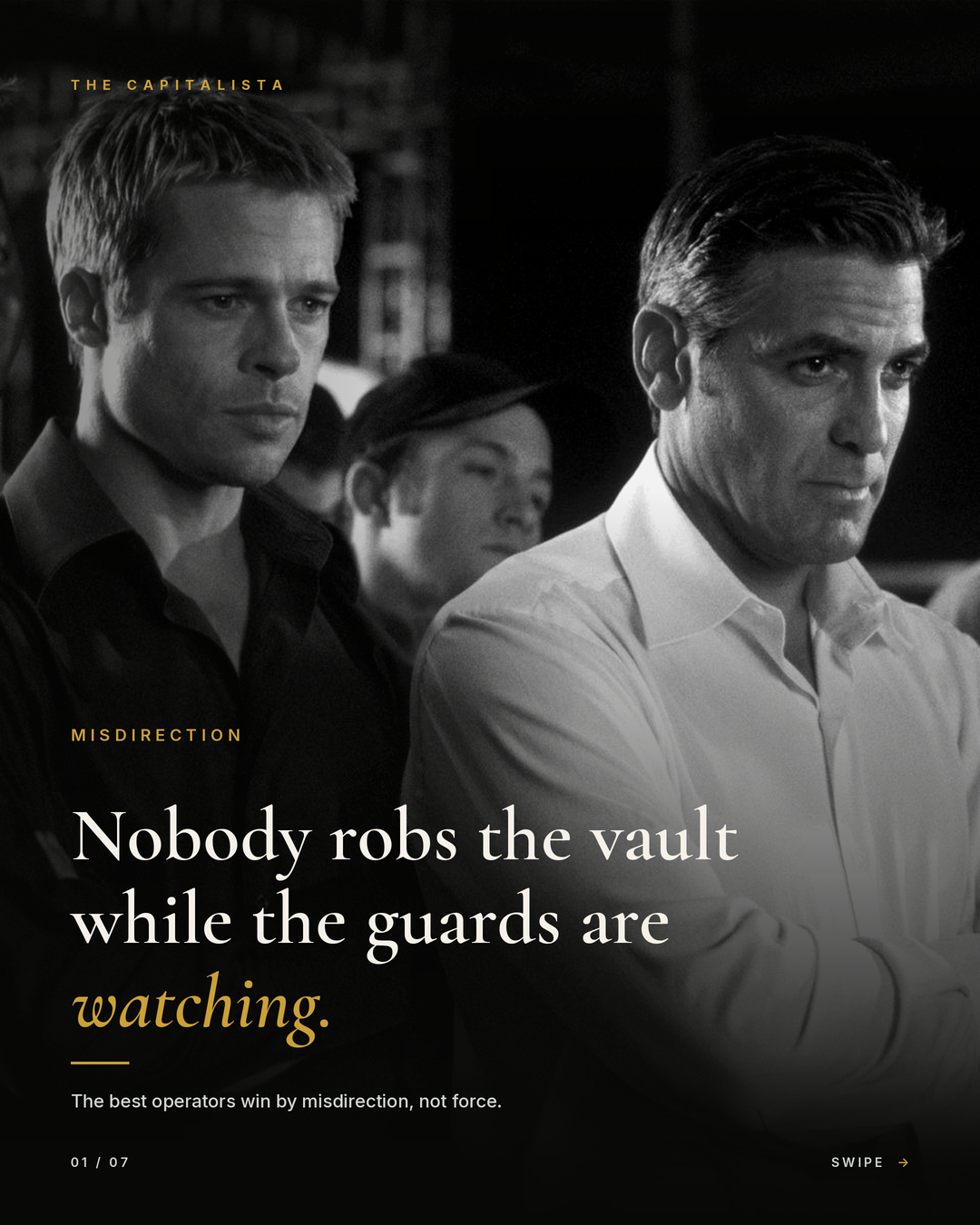
In every great heist story, the master thieves never try to blast through a secure vault door while the guards are watching.
That's the amateur move — loud, direct, and doomed. Instead, they orchestrate an elaborate, highly visible crisis somewhere else entirely: a fire, a blackout, a staged confrontation on the casino floor. Every security guard, every manager, every camera swings toward the commotion. And while all that attention is pointed at the spectacle, the real objective is quietly, cleanly achieved somewhere no one is looking.
By the time management realizes they were actually under attack, it's over. The distraction did its job. The target they never thought to defend has already been taken.
This is the logic of Ocean's Eleven, and it's far more than clever screenwriting. It's one of the most underused principles in competitive business strategy: you don't win high-stakes games by attacking head-on. You win through misdirection — by controlling where your competitors are looking.
Why competing head-on is the amateur move
The instinct, when you want to win a market or a negotiation, is to compete directly. Announce your intentions. Attack the incumbent where they're strongest. Charge the vault. It feels bold and decisive.
It's also the most expensive way to win, and often a losing strategy outright. Here's the core principle the heist crew understands and most operators don't: people can only defend against a threat they see coming.
The moment you telegraph your primary strategic goal — the market you're really after, the product that's actually your profit engine, the move that matters most — you hand every competitor exactly what they need to prepare. They mobilize resources. They cut prices. They lock down partners. They brace for the specific attack you just announced. You've traded the enormous advantage of surprise for the dubious satisfaction of a fair fight.
A head-on assault turns your best idea into a contested, defended, expensive battle. You end up fighting for the vault while the guards are wide awake and staring right at you.
The misdirection play: control where they look
The sophisticated alternative is Danny Ocean's play. Instead of hiding your intentions entirely — which is difficult — you actively direct your competitors' attention toward the wrong thing.
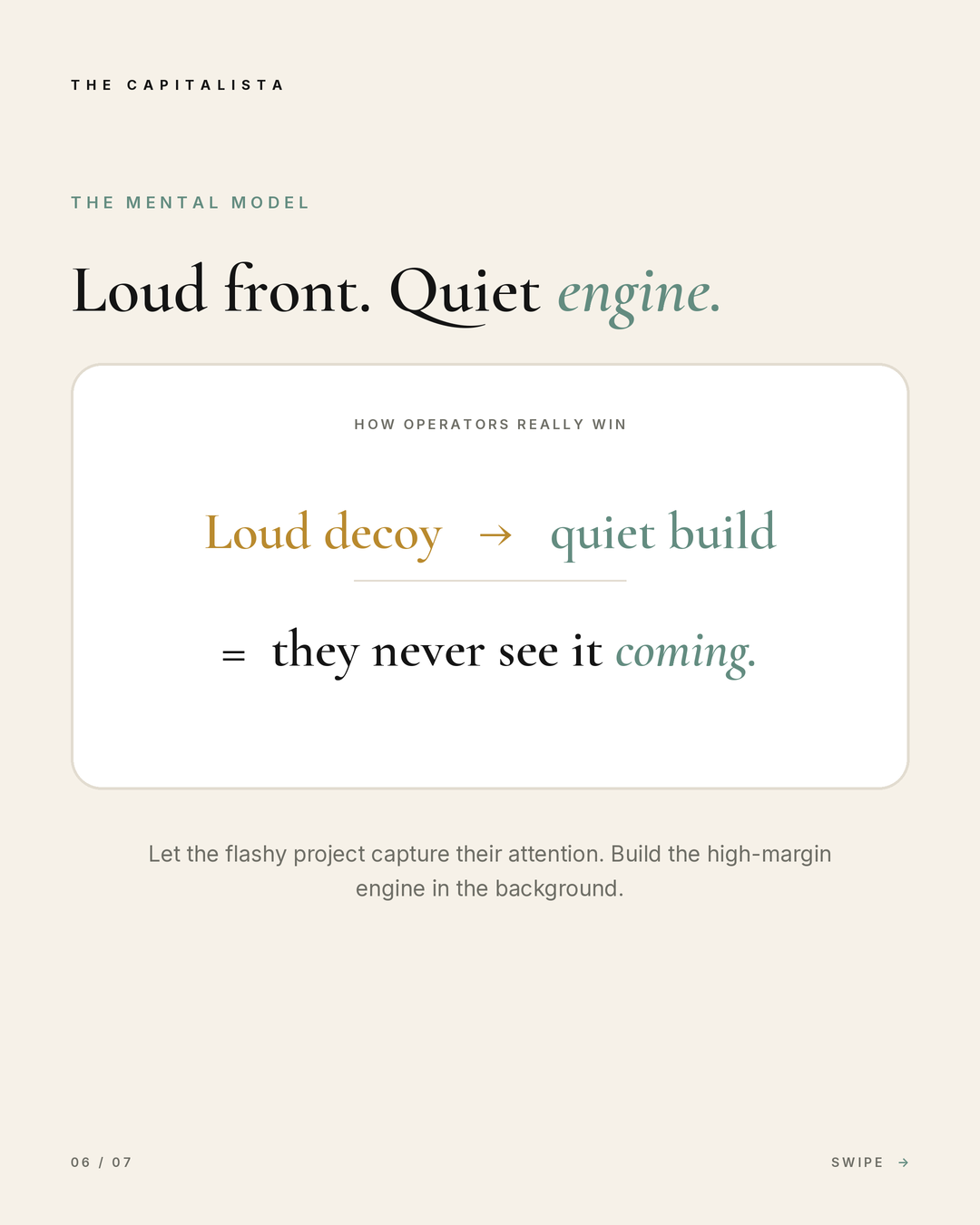
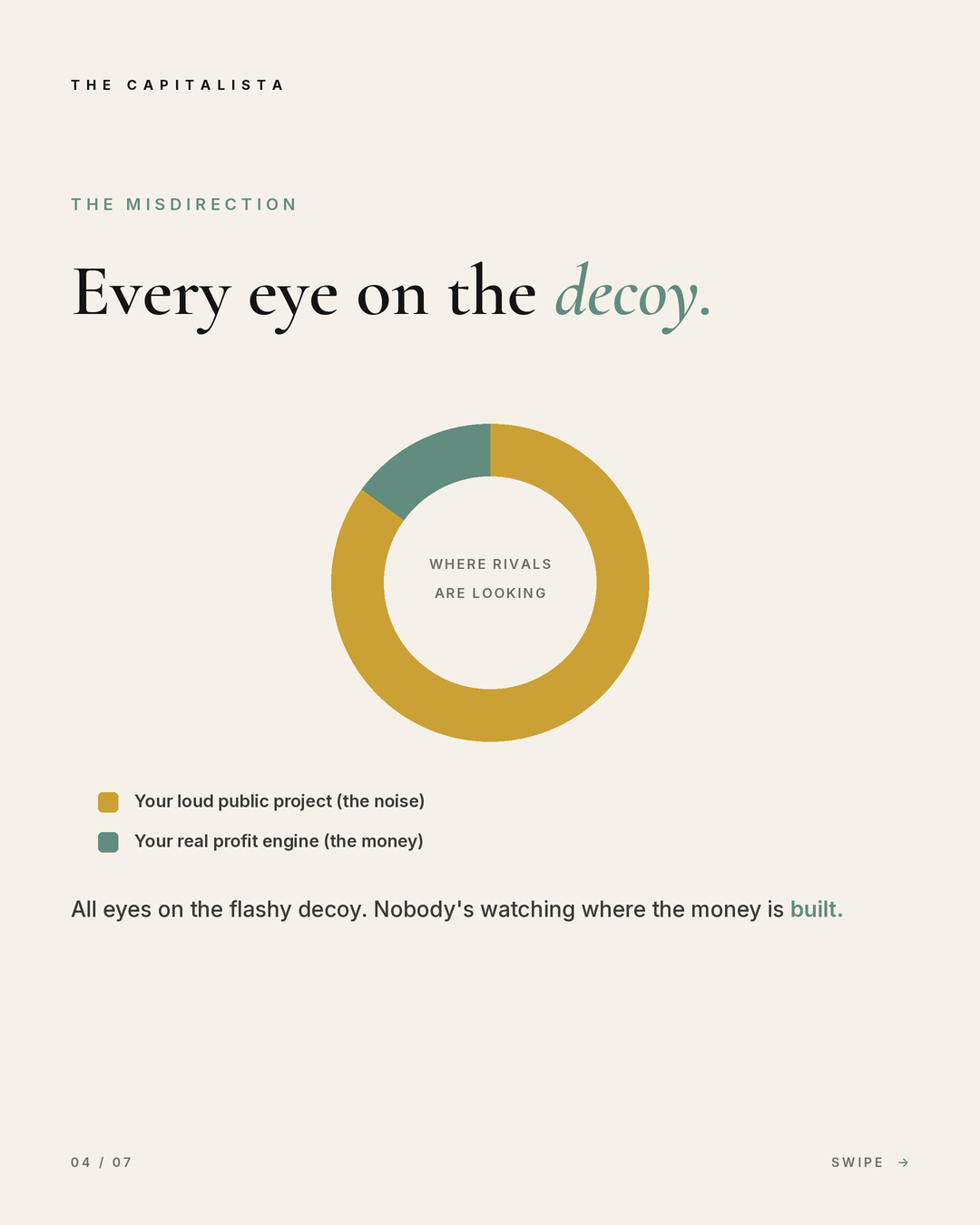
You build a loud, flashy, front-facing project: a highly visible product launch, an aggressive campaign, a public expansion, a headline-grabbing initiative. Something conspicuous enough to fully capture your rivals' attention and, crucially, their resources. This is the crisis on the casino floor. It's real enough to be credible and loud enough to be irresistible.
And while every competitor is watching that spectacle — matching your campaign, countering your launch, pouring energy into responding to your noise — you quietly construct the thing that actually matters. Your real, high-margin profit engine gets built in the background, in the space no one is guarding because no one is looking there.
The genius of the approach is that it uses your competitors' own attention against them. Their vigilance becomes a liability, because you decide where to point it. They defend the decoy with everything they have, and by the time they understand what you were really building, it's already operational and out of reach.
Attention is the real battlefield
The deeper insight beneath all of this is that in competitive markets, attention is the scarce resource, and whoever directs it wins.
Your competitors have finite time, finite budgets, and finite focus. Every dollar and every hour they spend reacting to your visible moves is a dollar and an hour they aren't spending discovering your real one. Misdirection isn't about deception for its own sake; it's about resource allocation. You're choosing where the competition spends its energy, and you're choosing to make them spend it on the thing that doesn't threaten you.
This reframes strategy entirely. The question stops being "how do I beat them at the obvious game?" and becomes "how do I make sure the obvious game isn't the one that matters?" The loud project isn't a waste — it's a deliberate investment in controlling the battlefield. The quiet engine is where the actual value compounds, precisely because it grows unnoticed and undefended.
How to apply strategic misdirection in your business
This principle sounds cinematic, but it maps directly onto everyday strategic decisions. Here's how to put it to work.
Separate your noise from your engine. Get explicit about the difference between the parts of your business that are visible and the parts that actually generate durable, high-margin profit. Many founders can't clearly name their real profit engine — which means they're defending everything and protecting nothing.
Stop announcing your primary goal. The move that matters most is the one you should telegraph least. Keep your real strategic objective quiet, and resist the ego-driven urge to broadcast your best idea before it's built and defensible.
Build a credible, visible front. Give the market — and your competitors — something legitimate and attention-worthy to focus on. It doesn't have to be a trick; it can be a real initiative that's simply louder than your core play. The point is that it absorbs the attention your quiet engine needs to grow undisturbed.
Grow the engine in the background. Develop your high-margin core deliberately and quietly, out of the spotlight. Let it reach real strength before it becomes obvious, so that by the time competitors notice, it's already established and hard to attack.
Audit where your rivals are actually looking. Before your next campaign or expansion, ask a simple question: are competitors focused on my public noise, or on my actual profit centers? If they can see the engine, you've announced the wrong thing.
When misdirection is the wrong tool
Like any strategy, this one has limits, and applying it blindly is a mistake.
Misdirection is a tool for competitive positioning, not a license for dishonesty toward customers. Directing a rival's attention away from your core business is smart strategy; misleading the people who actually pay you is a fast way to destroy trust and, sometimes, to break the law. Keep the distinction sharp: you're managing what competitors focus on, not deceiving your market.
It also requires the discipline to keep quiet. The entire advantage comes from restraint — from resisting the urge to show off your best move before it's ready. If you can't keep the engine quiet, the strategy collapses, because a decoy only works when the real target stays hidden.
The takeaway: let them watch the decoy
Danny Ocean never wins by being stronger than the vault. He wins by being smarter about attention — by making the entire security apparatus look the wrong way at the decisive moment. The target was never really defended, because it was never seen as the target.
Your business operates on the same principle more than you'd expect. Announce your best move and you invite a defended, expensive fight. Direct your competitors' attention toward a loud, visible front while you quietly build the real engine, and you win the game before they realize it started.
So before your next launch or expansion, look at the board the way a heist crew would. Make sure the thing everyone can see is the decoy — and that the thing that actually makes you money is the one no one is watching.
Frequently asked questions
What is misdirection in business strategy? It's the practice of directing competitors' attention and resources toward a loud, visible initiative while you quietly build your real, high-margin profit engine in the background. Like a heist crew staging a distraction, you control where rivals focus so your most important move grows undefended and unnoticed.
Why is competing head-on considered a weak strategy? Because people can only defend against a threat they see coming. Announcing your primary goal gives competitors the time and information to prepare, mobilize resources, and counter you directly — turning your best idea into an expensive, contested fight instead of a decisive advantage.
Isn't strategic misdirection just being dishonest? No. Misdirection is about managing where competitors focus their attention, not deceiving your customers. Directing a rival's energy toward a visible front is legitimate positioning; misleading the people who pay you is a different thing entirely and erodes the trust your business depends on.
How do I identify my real profit engine? Separate the visible parts of your business from the parts that generate durable, high-margin profit. Look for where the money actually compounds rather than where the attention goes. If you can't clearly name your profit engine, that's the first problem to solve — you can't protect what you haven't identified.