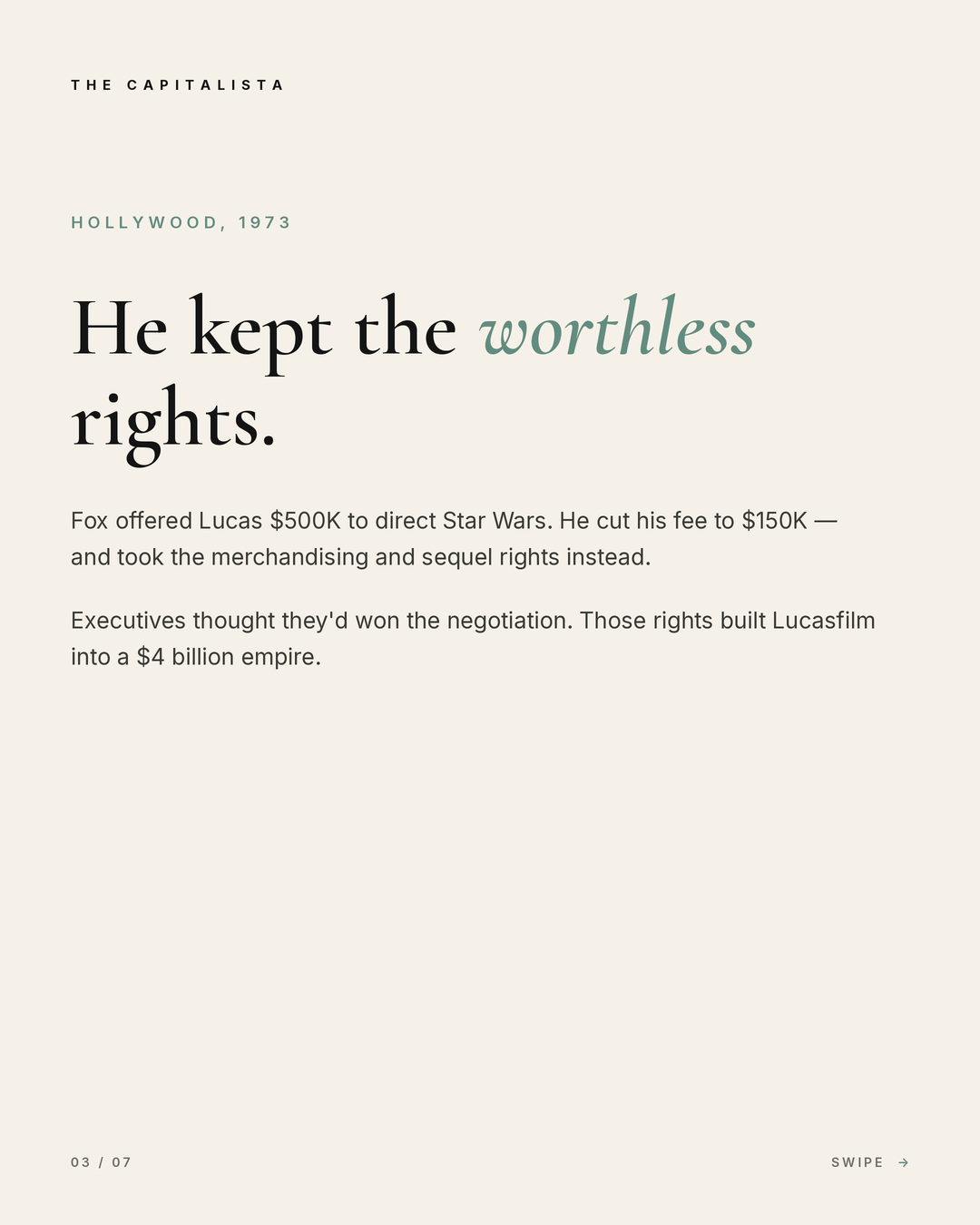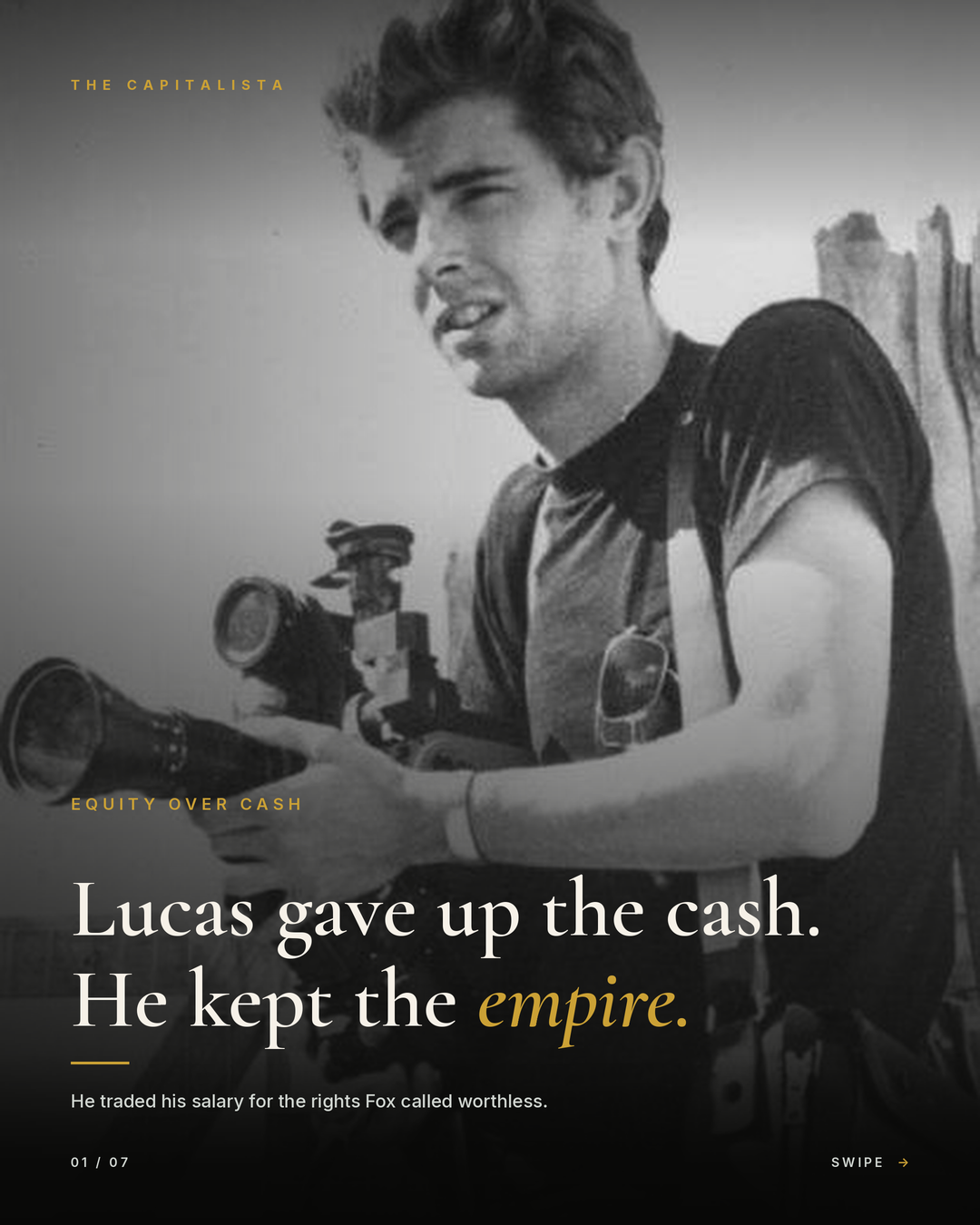
In 1973, 20th Century Fox offered George Lucas $500,000 to direct a strange, risky science-fiction film that almost no one inside the studio believed in.
For a young director, it was a substantial, guaranteed payday.
Lucas turned most of it down.
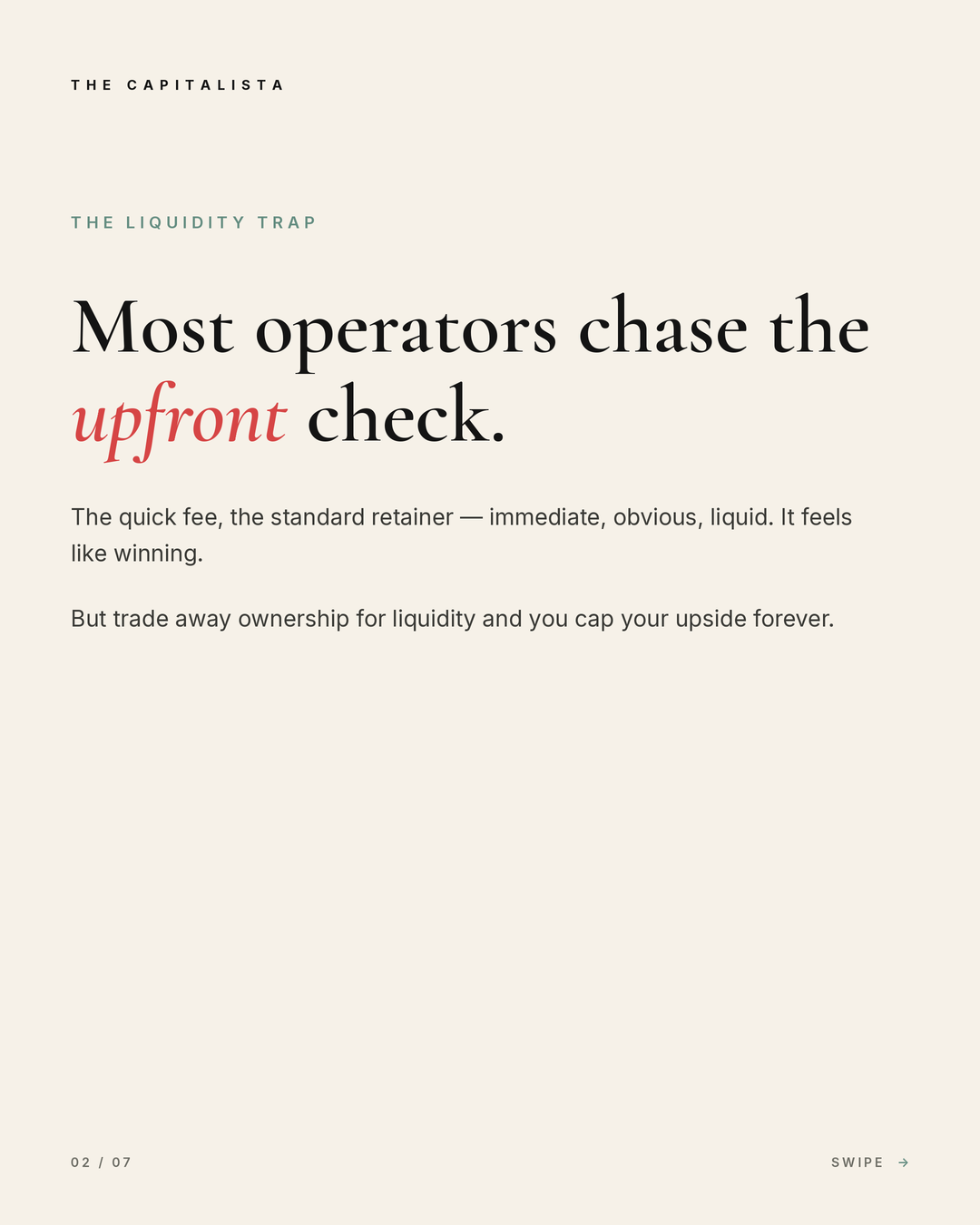
Instead, he made one of the most counterintuitive trades in business history. He cut his directing fee from $500,000 to $150,000, and in exchange asked for two assets the studio considered close to worthless: the merchandising rights and the sequel rights to the film. At the time, movie merchandise was an afterthought — nobody expected action figures and lunchboxes to generate real money. The executives happily handed those rights over, confident they'd won the negotiation.
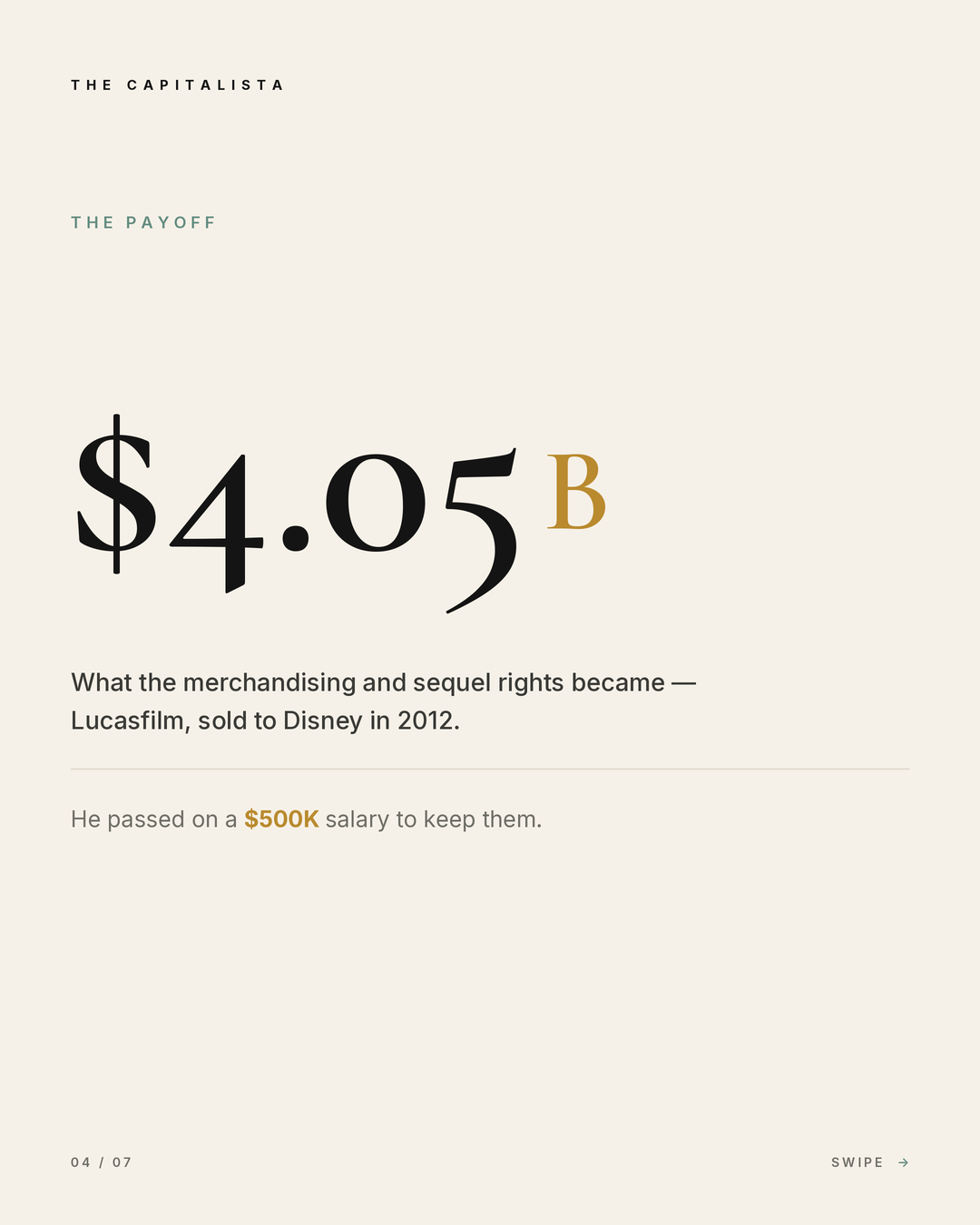
They had not. Those "worthless" rights became the foundation of Lucasfilm, a franchise whose merchandising alone has generated tens of billions of dollars, and which Lucas eventually sold to Disney in 2012 for $4.05 billion.
It's a perfect illustration of a principle every founder and operator should internalize: the market consistently overvalues immediate, obvious cash and undervalues long-term, unproven ownership. Choosing equity over cash — when you can afford to — is one of the highest-leverage wealth decisions you will ever make.
Why the market overvalues the upfront check
There's a reason the Fox executives made the trade they did, and it's the same reason most operators repeat the mistake today: immediate cash is legible, and future ownership is not.
A $500,000 salary is concrete. You can model it, bank it, and feel it. The value of merchandising rights to an unreleased film, by contrast, is speculative, illiquid, and easy to dismiss. Faced with the certain versus the uncertain, human beings — and the institutions they run — reliably overweight the certain thing in front of them.
This bias shows up everywhere in business. Founders take the quick consulting fee instead of a small equity stake. Agencies bill a flat retainer and hand the intellectual property they create straight to the client. Operators optimize for this quarter's revenue while signing away the asset that could have compounded for a decade. Each decision feels prudent in isolation. Each one quietly trades a potentially appreciating asset for a one-time payment.
The discipline Lucas demonstrated was the willingness to look past the obvious number and ask a different question: not "what is this worth today?" but "what could this become, and who will own it when it does?"
Cash pays once. Equity compounds.
The core financial distinction is simple, and it's the whole game.
A salary, a fee, or a retainer is a one-time, linear payment. You exchange your time or your work for a fixed sum, and the transaction ends. There is a ceiling, and you hit it the moment the check clears.
Ownership is non-linear. An asset you control — a brand, a piece of intellectual property, a catalog, a proprietary framework, a product — can keep generating value long after the work that created it is done. It can appreciate. It can be licensed, sold, or borrowed against. It has no inherent ceiling. Lucas's directing fee paid him once in 1977. His ownership paid him, and continued to pay him, for the next thirty-five years.
This is why the wealthiest operators are rarely the highest-paid ones. High income is linear; it stops when you stop. Real, compounding fortune belongs to the people who accumulate assets — things they own that work whether or not they show up. The salary funds your life. The equity builds your net worth.
The founder's version of the Lucas trade
Most operators will never negotiate film rights, but the same trade presents itself constantly, usually disguised as a routine business decision. Recognizing it is the entire skill.
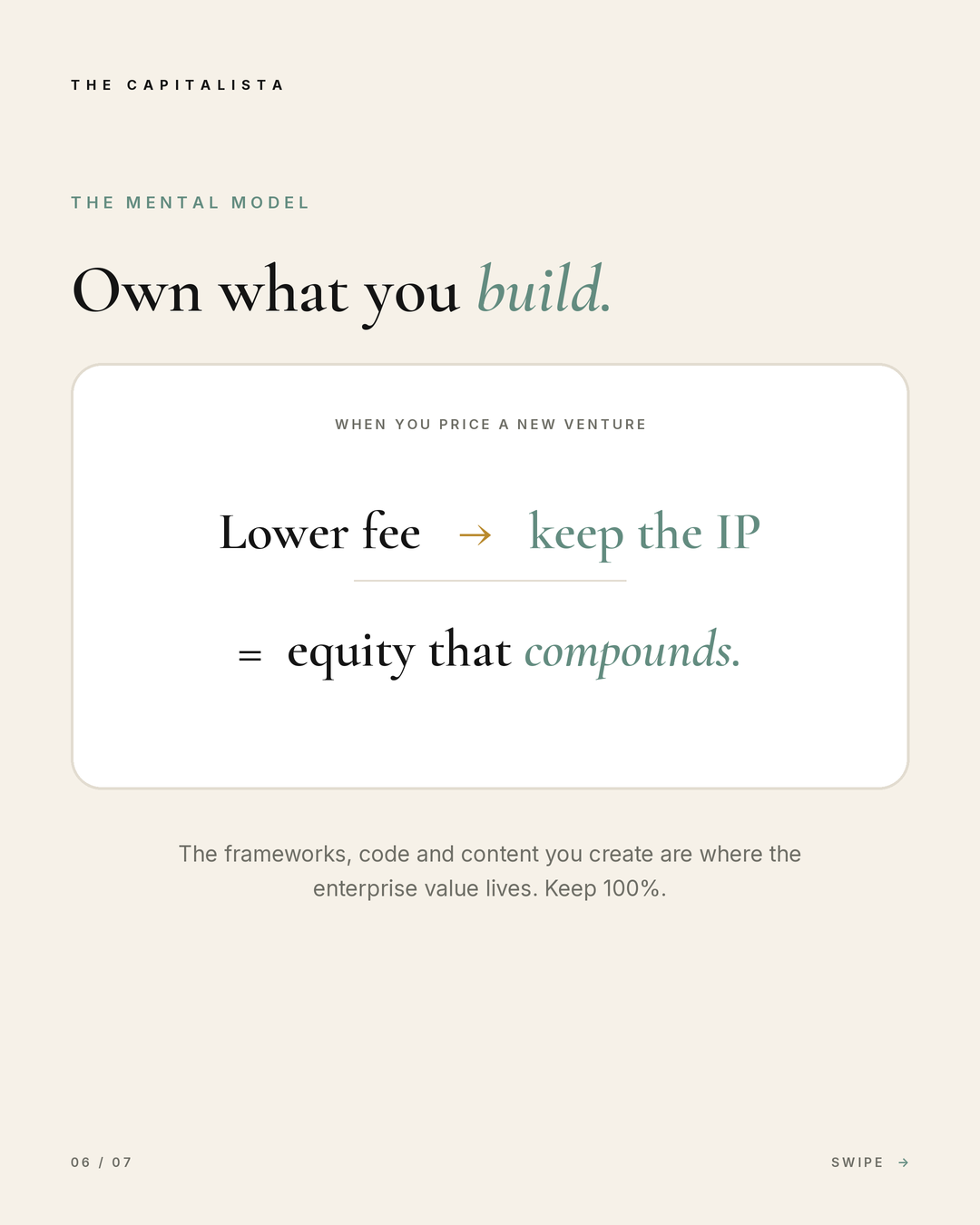
Retain the IP you create. When you build software, frameworks, content, designs, or systems for clients, the default contract often assigns all of that intellectual property to the client. Sometimes that's appropriate and well-compensated. Often it's a reflex — you hand over the most valuable, reusable thing you produced in exchange for a project fee. Wherever you can, structure the work so you retain ownership of the underlying tools and frameworks, and license their use rather than selling them outright.
Take equity where the upside is real. When you can afford to, trading some immediate cash for a meaningful ownership stake in a venture, partnership, or product can be worth many multiples of the fee you gave up. The key qualifier is when you can afford to — Lucas took a lower fee, not no fee. Equity is a bet, and you make bets with money you can survive losing.
Productize instead of renting your time. A retainer rents your hours. A product, a piece of software, a course, or a piece of content is an asset you own and can sell repeatedly. Converting linear, time-for-money work into ownable, sellable assets is the everyday version of choosing the rights over the salary.
Read the ownership clauses before the dollar figure. In any contract or joint venture, the most consequential terms are usually not the headline fee — they're the clauses governing who owns what is created. Those clauses set the ceiling on your long-term upside, and they're the ones most operators skim.
When cash is actually the right call
Choosing equity over cash is a principle, not a religion, and applying it blindly is its own mistake.
Ownership is a bet on the future, and bets require staying power. If you can't pay your bills, taking a lower fee for speculative equity isn't visionary — it's reckless. Lucas could afford a smaller directing fee; he wasn't risking the rent. Early-stage operators often need liquidity to survive long enough to own anything at all, and there is no shame in taking the cash when the cash is what keeps the doors open.
The point is not to refuse money. It's to stop reflexively taking the obvious check without ever weighing it against the ownership you're giving up. The goal is a deliberate decision, made with eyes open, rather than a default that quietly caps your upside for years.
The takeaway: own what you build
George Lucas didn't get rich because Star Wars was a hit. Plenty of people made that film a hit and walked away with a paycheck. He got rich because, before anyone knew it would be a hit, he insisted on owning the assets it would generate.
That's the lesson, and it's reproducible at any scale. The frameworks you develop, the code you write, the content you publish, the brand you build — that is where the enterprise value actually lives. The check you get for the work is almost never where the real money is.
So before you sign the next contract, take the next retainer, or accept the next flat fee, ask the question Lucas asked: what am I building here that could compound, and am I keeping it? Then protect that ownership as if your future net worth depends on it — because it does.
Frequently asked questions
What does "equity over cash" mean? It means choosing long-term ownership of an asset — equity, intellectual property, a brand, a product — over an immediate, one-time payment when you can afford to. Cash pays once; ownership can appreciate and generate value for years, giving it a far higher long-term ceiling.
Did George Lucas really give up a salary for Star Wars rights? Yes. In 1973 he reduced his directing fee from a reported $500,000 to $150,000 in exchange for the merchandising and sequel rights, which Fox considered low-value. Those rights became the basis of Lucasfilm, which sold to Disney in 2012 for $4.05 billion.
Should founders always choose equity instead of cash? No. Ownership is a bet that requires financial staying power. If you need liquidity to keep your business alive, taking the cash can be the correct decision. The principle is to weigh the trade deliberately rather than reflexively taking the upfront check.
How do I keep ownership of the work I do for clients? Review the intellectual property clauses in your contracts. Where possible, structure agreements so you retain ownership of the underlying frameworks, code, or systems you build and license their use, rather than assigning all rights to the client by default.