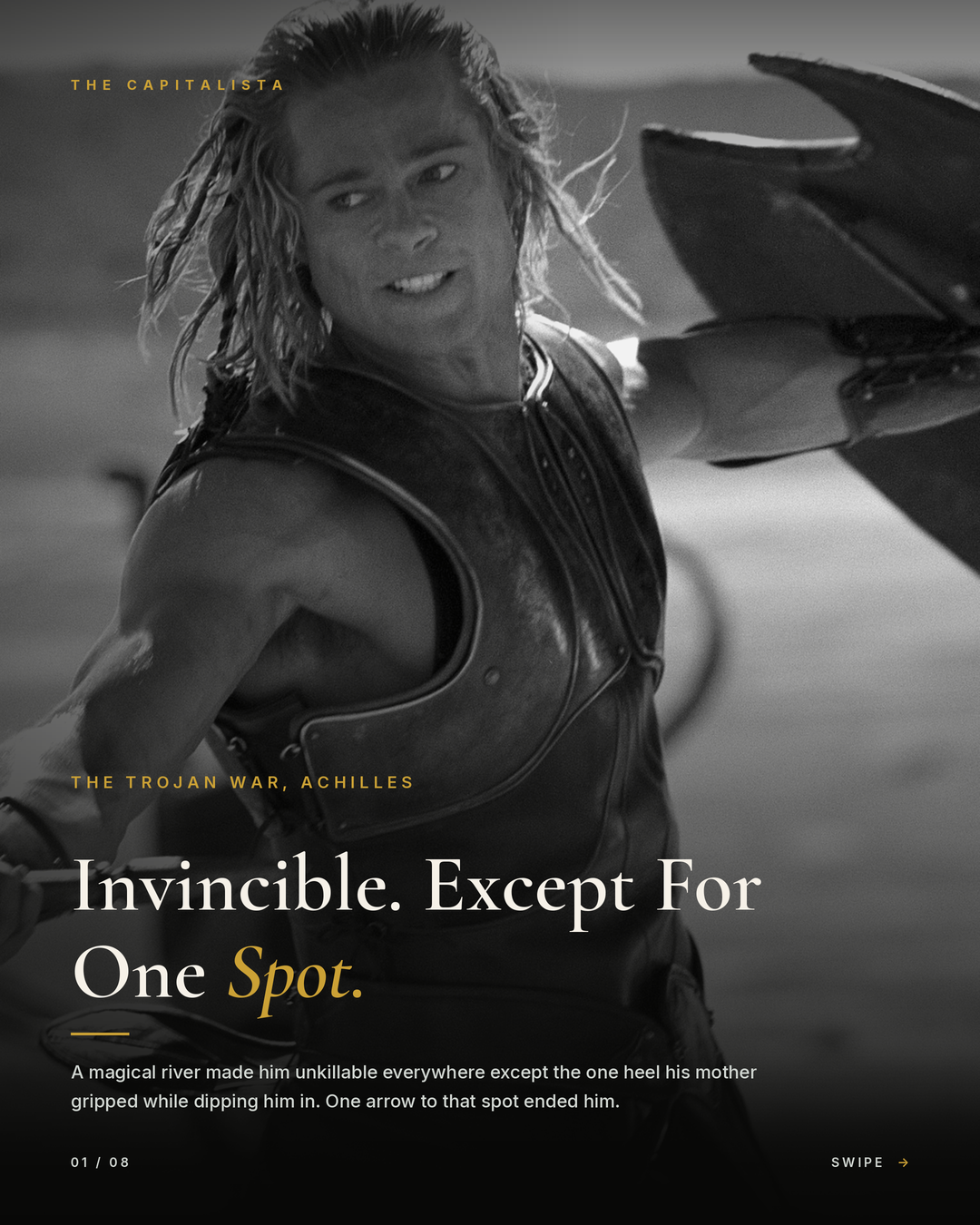
Achilles was the ultimate apex predator of the Trojan War. As an infant, his mother dipped him into a magical river, and his flesh became completely impenetrable.
Swords couldn't cut him. Spears couldn't pierce him. On every battlefield he ever stepped onto, he looked and fought like a man who simply could not be killed.
He had exactly one unprotected spot. His mother had held him by the heel while dipping him into the river, and that single small area, gripped in her hand, never touched the water. It stayed completely unprotected for his entire life, unnoticed by everyone, including Achilles himself.
His enemies never needed to defeat him in open combat. They never needed to overpower his strength or match his skill. They needed exactly one thing: to find the single place nobody had ever examined, and land one arrow in it.
This is one of the most famous stories in Western mythology, and it contains one of the most consistently underestimated risks in business. Visible strength doesn't protect you from invisible exposure. It just makes the exposure harder to see, because everything else looks so undeniably strong.
Why the Invulnerability Was the Problem, Not the Solution
Here's the part of this story most people gloss over: Achilles's near-total invincibility wasn't just irrelevant to his eventual death. It actively contributed to it. Because he was so thoroughly protected everywhere else, nobody, including Achilles, ever had reason to examine his body for weakness. Total strength in every visible dimension created total blindness about the one dimension where strength didn't exist.
This is precisely the trap that catches well-run, successful businesses. A company with a dominant market position, strong revenue growth, and a polished public brand looks, from every visible angle, like it can't be beaten. That same visible strength is exactly what prevents anyone inside the organization from rigorously examining where the real structural weakness might be hiding. Success doesn't just fail to reveal your vulnerabilities. It actively discourages anyone from looking for them.
The Single Point of Failure Nobody Checks
Every business, no matter how well-built, has at least one Achilles heel: a single point of failure that, if compromised, could bring down far more than its apparent size would suggest. The reason these points of failure persist undetected for so long isn't that they're impossible to find. It's that nobody has a reason to look, because everything else about the business appears strong.
This might be a single vendor relationship that the entire supply chain quietly depends on, with no real backup plan if that relationship ends. It might be one key employee holding critical, undocumented institutional knowledge that nobody else in the company has. It might be a single digital traffic source or customer acquisition channel that the entire growth engine depends on, invisible until an algorithm change or platform policy shift removes it overnight. In every case, the pattern is the same: massive visible strength surrounding one small, completely unexamined point of total exposure.
Why Competitors Don't Need to Beat Your Whole Business
This is the part of the Achilles story with the sharpest implications for how you should think about competitive risk. Achilles's enemies never needed a strategy for defeating his overall strength. That would have been a losing approach against a warrior nobody could match in open combat. They needed a strategy for finding the one place his strength didn't extend, and that strategy required far less effort than a frontal assault would have.
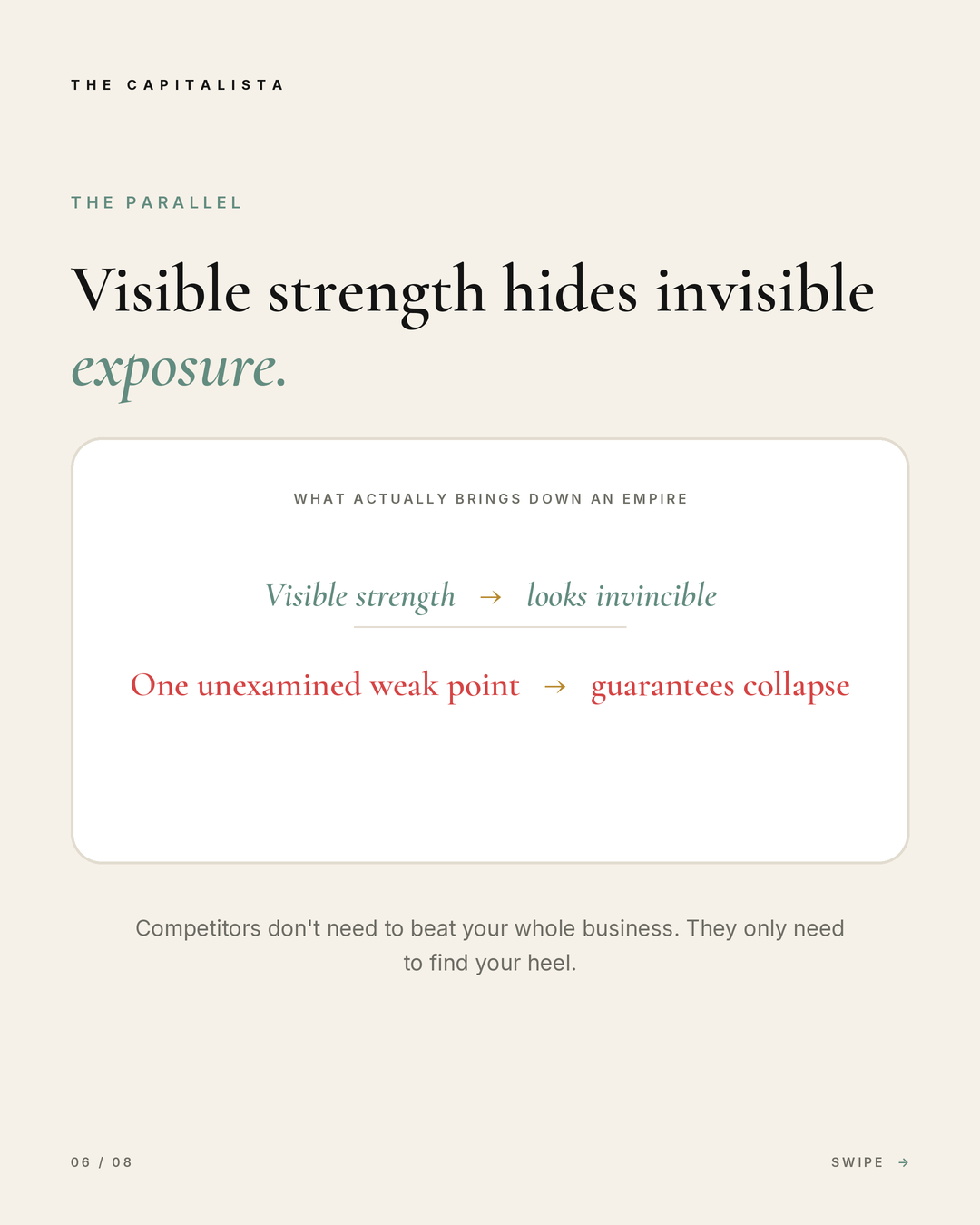
The same asymmetry applies directly to business competition. A competitor doesn't need to out-execute you across your entire operation to seriously damage you. They need to find the one place your operation is quietly, invisibly exposed, and apply pressure there. This is a far more efficient path to disrupting a strong competitor than trying to beat them head-on across every dimension where they're genuinely strong, and it's exactly the path sophisticated competitors and market disruptors actually take.
Why Visible Strength Actively Hides Invisible Exposure
There's a specific psychological mechanism at work here that's worth naming directly. The more visibly successful a business becomes, the more its leadership tends to interpret that visible success as evidence of overall structural soundness. This is an understandable but dangerous inference. Visible strength in the dimensions everyone can see, revenue, brand, growth rate, tells you almost nothing about structural weakness in a dimension nobody's been looking at.
Founders build massive sales engines and pristine public brands, and it's easy to unconsciously assume that visible strength implies the enterprise is invincible everywhere. It doesn't. The businesses most vulnerable to a single point of failure are often the ones whose overall visible strength is so convincing that nobody inside the organization feels any urgency to go looking for the one spot the water never touched.
The Kinds of Heels Businesses Actually Have
The specific form a business's Achilles heel takes varies, but they tend to cluster around a few recognizable patterns. A single supplier or vendor whose failure would halt operations entirely, with no contingency plan because the relationship has simply always worked. A key person whose departure would take irreplaceable knowledge and relationships with them, because nothing critical was ever documented or cross-trained. A concentrated customer base where a small number of accounts represent an outsized share of revenue, invisible risk until one of them leaves. A single technology platform, marketing channel, or piece of infrastructure that the entire business quietly depends on, with no real fallback if it changes or disappears.
In every case, the defining feature isn't that the risk is exotic or hard to imagine. It's that nobody has run the specific exercise of asking "what is the one thing that, if it failed tomorrow, would do disproportionate damage to everything else we've built?"
How to Find Your Own Heel Before Someone Else Does
1. Stop assuming visible strength implies structural soundness
The first step is recognizing that a strong balance sheet, strong revenue, and a strong brand tell you nothing about whether a single point of failure exists elsewhere in the business. Treat visible success and structural resilience as two completely separate questions.
2. Map your dependencies systematically
List every vendor, employee, customer concentration, and piece of infrastructure your business depends on. For each one, ask a direct question: if this disappeared tomorrow with no warning, how much damage would it do, and how quickly could you recover?
3. Identify the dependencies with no backup plan
Most dependencies on your list will have some form of redundancy or contingency already. The ones that matter are the ones that don't: the single vendor with no alternative, the one person whose knowledge lives only in their head, the customer concentration with no diversification plan in progress.
4. Build redundancy before you need it
Once you've identified a genuine single point of failure, build the redundancy while you have the luxury of time: document the institutional knowledge, diversify the vendor relationship, reduce the customer concentration, build the backup channel. Waiting until the point of failure actually fails removes your ability to respond calmly.
5. Make this a recurring exercise, not a one-time audit
New single points of failure emerge as a business grows and changes. What was a well-diversified dependency two years ago can quietly concentrate into a new heel without anyone noticing, precisely because everything else about the business continues to look strong. Revisit this exercise regularly, not just once.
What The Capitalista Does
Most founders can describe their company's visible strengths in detail: revenue growth, market position, brand reputation. Far fewer can describe, with the same confidence, the single dependency that would do the most damage if it failed tomorrow.
The Capitalista is a fractional CFO service built to find exactly that blind spot. We:
- Stress-test your operations and financials for concentrated dependencies you can't easily see from inside the business
- Map vendor, customer, and revenue concentration risk that often hides behind otherwise strong-looking numbers
- Identify the single points of failure most likely to cause disproportionate damage relative to their visibility
- Build redundancy and contingency plans before a dependency fails, not after
- Protect your enterprise value by closing the exact kind of structural gap that visible success tends to obscure
Achilles didn't need more strength. He needed someone to notice the one place the river never touched. Most businesses have exactly that same gap, hiding in plain sight behind everything that's currently working.
Frequently Asked Questions
What is the business lesson from the Achilles myth?
The lesson is that visible strength across most of a business doesn't guarantee structural soundness everywhere. A single unexamined point of failure, however small, can be enough to cause disproportionate damage, precisely because the surrounding strength discourages anyone from looking for it.
What does a "single point of failure" look like in a real business?
Common examples include a critical vendor relationship with no backup, a key employee holding undocumented institutional knowledge, a customer base concentrated in a small number of accounts, or a single marketing channel or platform the business depends on disproportionately.
Why don't successful businesses notice their own single points of failure?
Because visible success in other areas, revenue growth, brand strength, market position, creates a false sense of overall structural soundness. The more convincing that visible strength is, the less urgency there is internally to look for weaknesses hiding behind it.
How do I find my company's Achilles heel?
Systematically map every major dependency your business relies on, vendors, key employees, customer concentration, infrastructure, and ask what would happen if each one failed tomorrow with no warning. The dependencies with no real backup plan are your most likely points of failure.
How often should I check for new single points of failure?
Regularly, not just once. As a business grows and changes, dependencies that were once well-diversified can quietly concentrate into new vulnerabilities without anyone noticing, especially while everything else about the business continues to look strong.
The Bottom Line
Achilles didn't fall because an enemy outfought him. He fell because one small, unexamined spot was all it took, and nobody, including Achilles, had ever thought to check it. Your empire will not collapse from a frontal assault. It will shatter from the structural weakness you refuse to acknowledge.
Competitors don't need to beat your whole business. They only need to find your heel. The businesses that survive long-term aren't the ones with no weaknesses. They're the ones disciplined enough to go looking for their own before someone else finds it first.
What's the one dependency in your business that nobody has ever stress-tested? And what would happen tomorrow if it failed?