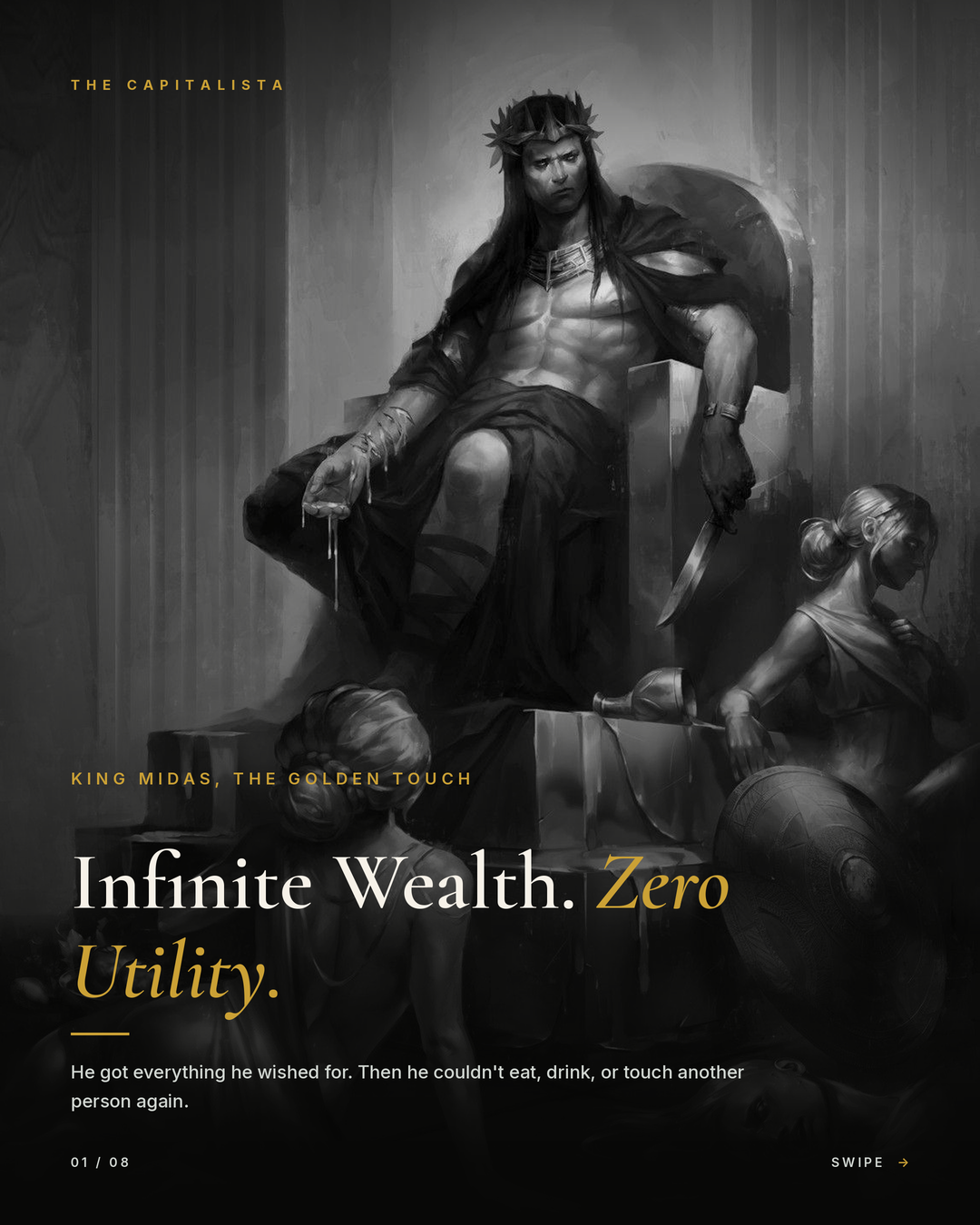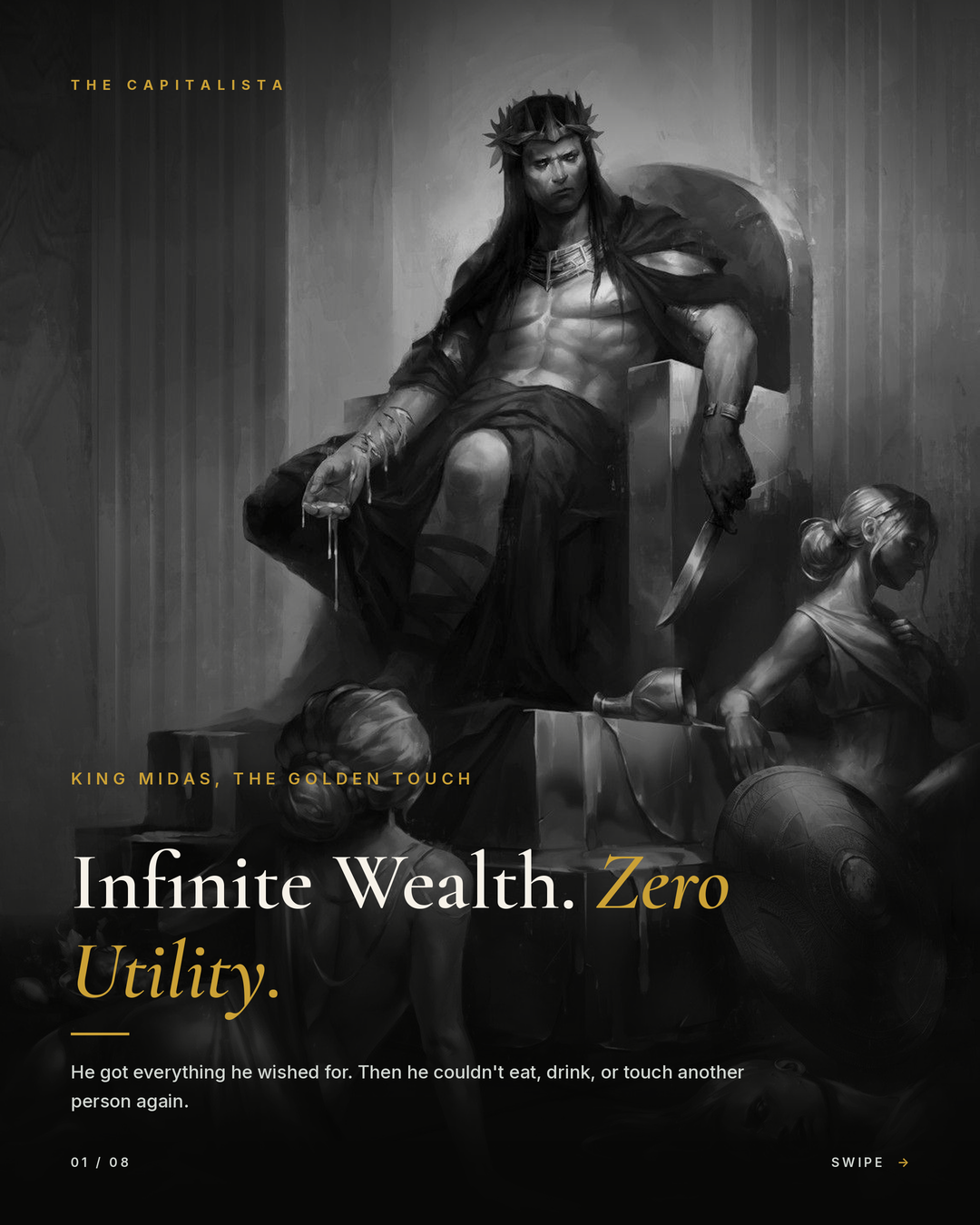
King Midas asked the gods for exactly one power: everything he touched would turn to gold.
The gods granted it without hesitation, and Midas rejoiced as his entire palace transformed into unimaginable wealth. Every wall, every table, every ordinary object he touched became solid gold. On paper, in a single afternoon, he became the richest man who had ever lived.
Then he sat down to eat.
The bread turned to gold in his mouth. The wine turned to metal in his throat. He couldn't eat. He couldn't drink. When his daughter ran to embrace him, overjoyed at his sudden fortune, she turned into a lifeless golden statue in his arms.
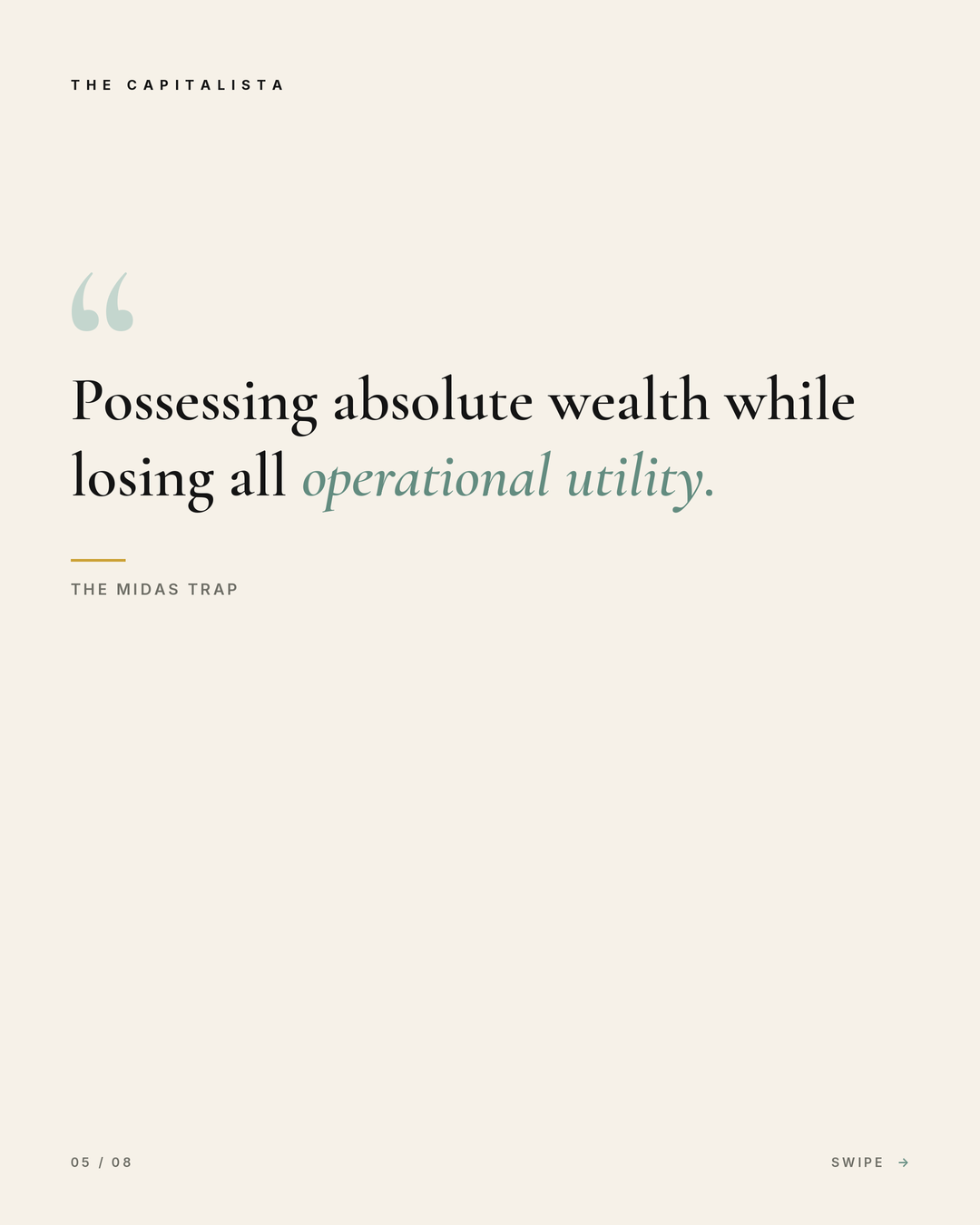
Midas had absolute wealth and zero operational utility. He was, by any measure of net worth, the wealthiest man alive, and he was actively starving to death surrounded by more gold than he could ever spend.
This myth is usually told as a simple parable about greed. It's actually a precise, devastating illustration of one of the most common and least discussed failure modes in business: the catastrophic difference between being wealthy on paper and having capital you can actually use.
The Seduction of the Golden Touch
It's worth sitting with why Midas's wish felt so obviously good to him in the moment. He wasn't asking for something reckless or foolish on its face. He was asking for the most direct, unlimited version of wealth imaginable: the ability to generate gold, the universal store of value, from literally anything he touched.
This is exactly the seduction that drives most founders toward the same trap. Massive valuation feels like the most direct, unlimited version of business success imaginable. A billion-dollar valuation, a soaring revenue multiple, a headline-grabbing funding round, these all feel like unambiguous wins, the startup equivalent of turning everything you touch into gold. Nobody sets out to build a company that's rich on paper and starving in practice. It happens because the golden touch looks identical to real wealth right up until the moment you try to use it.
What Midas Actually Discovered
The horror of the golden touch wasn't that gold is worthless. Gold is, in fact, extremely valuable. The horror was that Midas's specific form of wealth was completely inaccessible to him in the exact moments he needed to use it. He couldn't convert his gold into food. He couldn't convert it into a hug from his daughter. The asset was real, and the asset was completely illiquid in the forms of value he actually needed moment to moment.
This is the exact distinction most founders fail to internalize until it's already a crisis: an asset's paper value and an asset's usable value are not the same thing, and the gap between them can be the difference between survival and collapse. A company can be genuinely, legitimately valuable, the way Midas's gold was genuinely valuable, and still be unable to meet its most basic, immediate operational needs.
The Illusion Broken Down
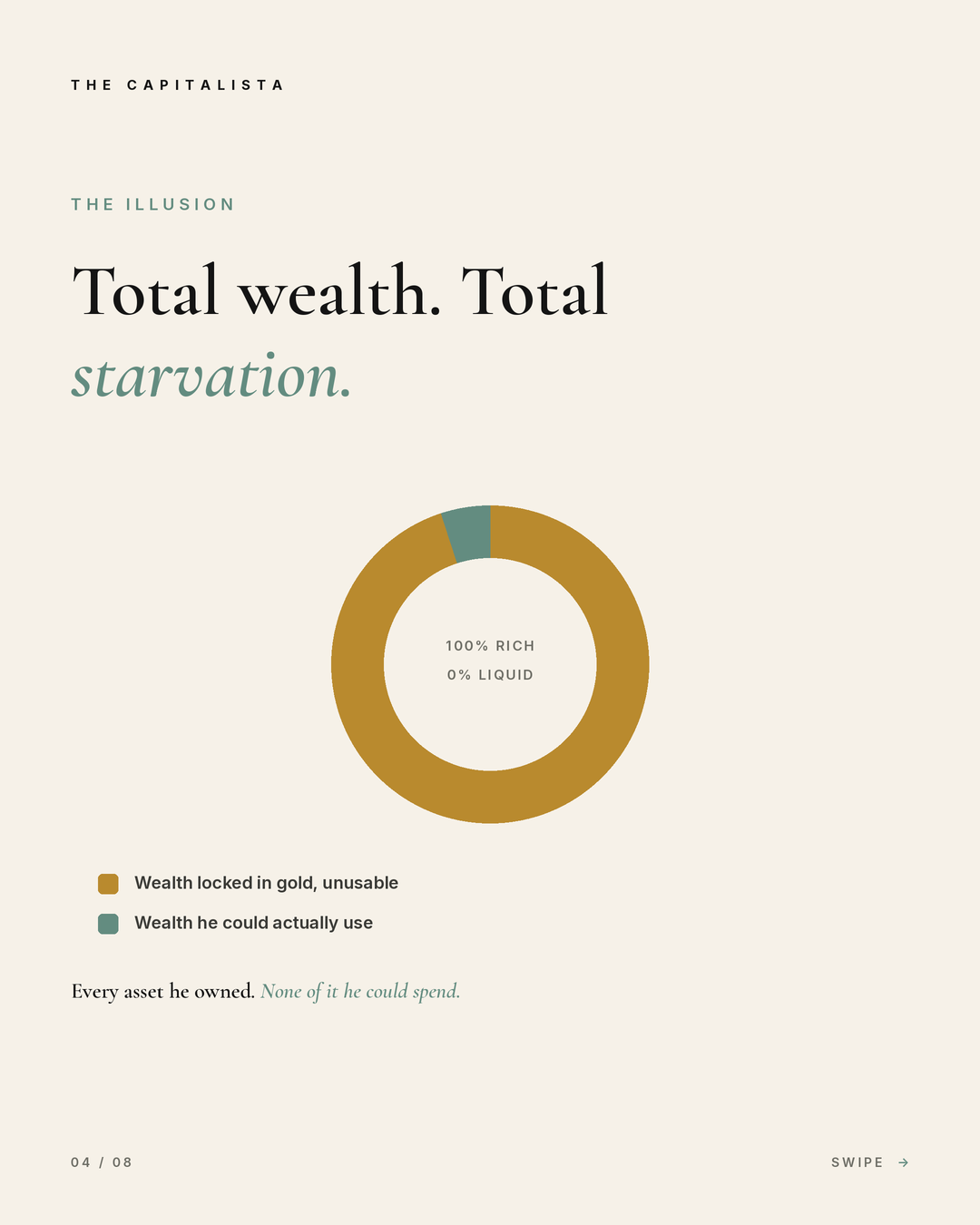
Consider what Midas's wealth actually looked like the moment it mattered most. Nearly all of it, the overwhelming majority of everything he owned, was locked into a form he had no ability to use for his immediate survival. Only a tiny fraction of what surrounded him retained any actual usability. He was, by any conventional measure, entirely rich. He was, by the only measure that mattered in the moment he needed to eat, entirely without resources.
This is precisely the situation many founders find themselves in without recognizing it. Every asset on the balance sheet, technically real. Every valuation number, technically defensible. And none of it available to cover payroll next month.
The Business Parallel Founders Keep Missing
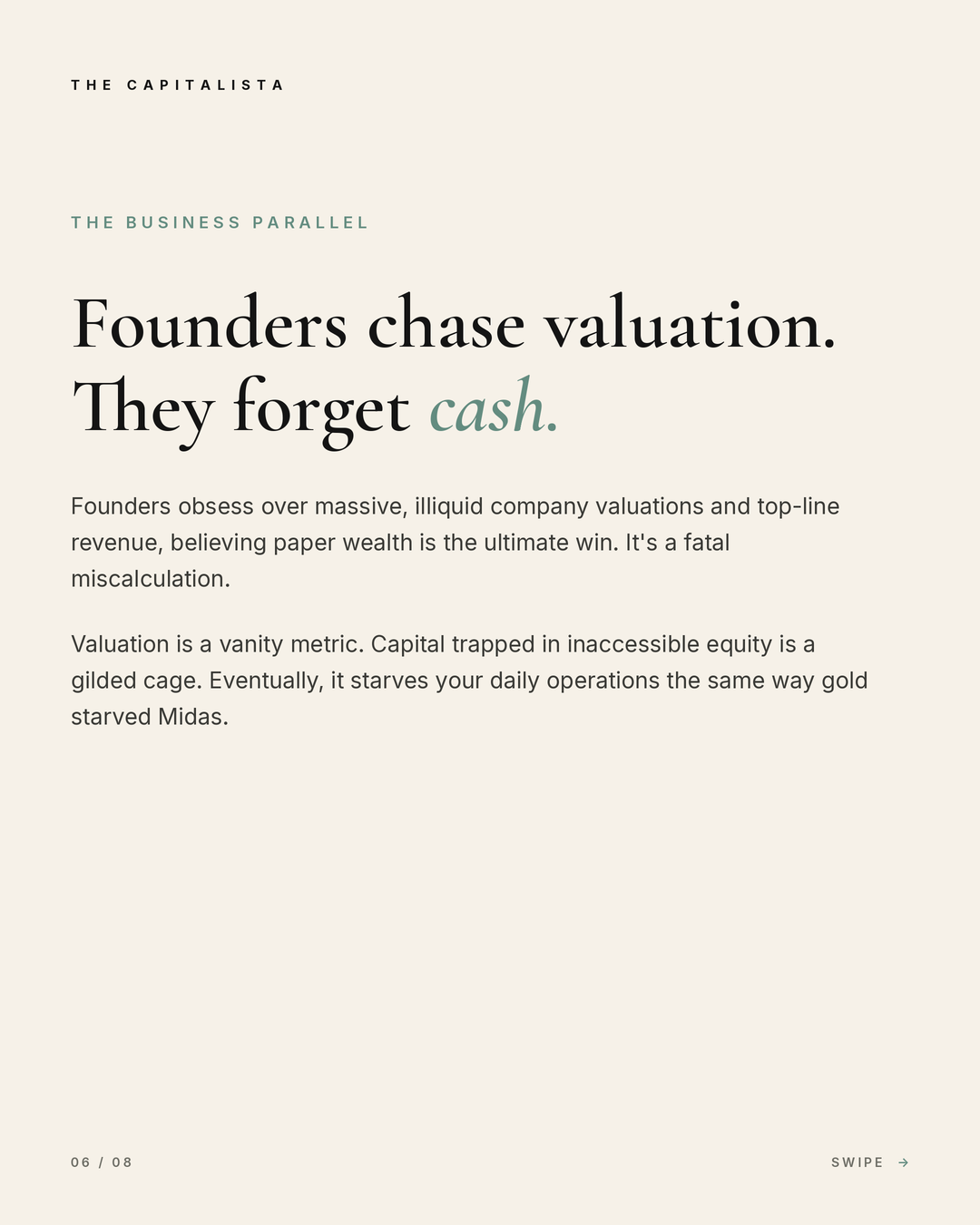
Founders chase valuation. They forget cash. This isn't a minor oversight, it's a fundamental miscalculation about what wealth actually is, and it's one of the most common reasons that companies with impressive headlines quietly collapse.
Massive, illiquid company valuations and top-line revenue numbers feel like the ultimate win, the startup equivalent of Midas's golden touch. But valuation is, in a very real sense, a vanity metric until it converts into something usable. A company valued at a hundred million dollars in its last funding round can still miss payroll if the actual cash available doesn't match the story the valuation tells. Capital trapped in inaccessible equity, whether that's illiquid ownership stakes, unrealized asset appreciation, or revenue tied up in slow-paying contracts, is a gilded cage. It looks like wealth. It behaves like starvation the moment you actually need to spend it.
This gap between paper wealth and usable capital rarely announces itself dramatically. It shows up quietly, in the growing distance between how healthy a company appears from the outside and how much actual runway exists to keep operating. Eventually, exactly the way gold starved Midas, that gap starves daily operations, regardless of how impressive the balance sheet looks from a distance.
Why This Trap Is So Easy to Fall Into
Nobody builds a Midas-trapped business on purpose. It happens because every individual decision that leads there feels rational in isolation. Raising at a high valuation feels like unambiguous progress. Reinvesting every available dollar into growth instead of building cash reserves feels like disciplined execution. Holding illiquid equity or long-term assets instead of converting them to cash feels like patient, sophisticated capital allocation.
Each of these decisions can be individually correct. The trap emerges from the aggregate effect: a business that looks increasingly wealthy from the outside while its actual, spendable liquidity fails to keep pace. By the time the gap becomes undeniable, it's often already a crisis, because nobody was tracking the difference between paper value and usable capital as a distinct, monitored metric.
The Real Cost of Confusing the Two
The cost of this confusion isn't abstract. It shows up in very specific, very painful ways. A company forced into a fire sale of valuable assets at a fraction of their worth because it needed cash immediately and had no liquid alternative. A founder unable to make payroll despite a balance sheet that would suggest, on paper, that the company was thriving. A business that has to accept dramatically unfavorable financing terms because its actual liquidity position gave it no leverage, regardless of what its valuation implied it should have had.
In every one of these cases, the underlying problem wasn't a lack of value. It was a lack of usable value at the moment it was needed most, precisely the trap that turned Midas's blessing into a curse.
How to Apply This to Your Own Business
1. Separate your paper wealth from your usable wealth explicitly
Build a simple, honest accounting of what you actually have access to right now versus what exists as value you can't currently spend: illiquid equity, unrealized valuation gains, long-term contracts, slow-paying receivables. Most founders have never actually separated these two categories cleanly, and doing so is often the first moment the real gap becomes visible.
2. Review your balance sheet for trapped assets today
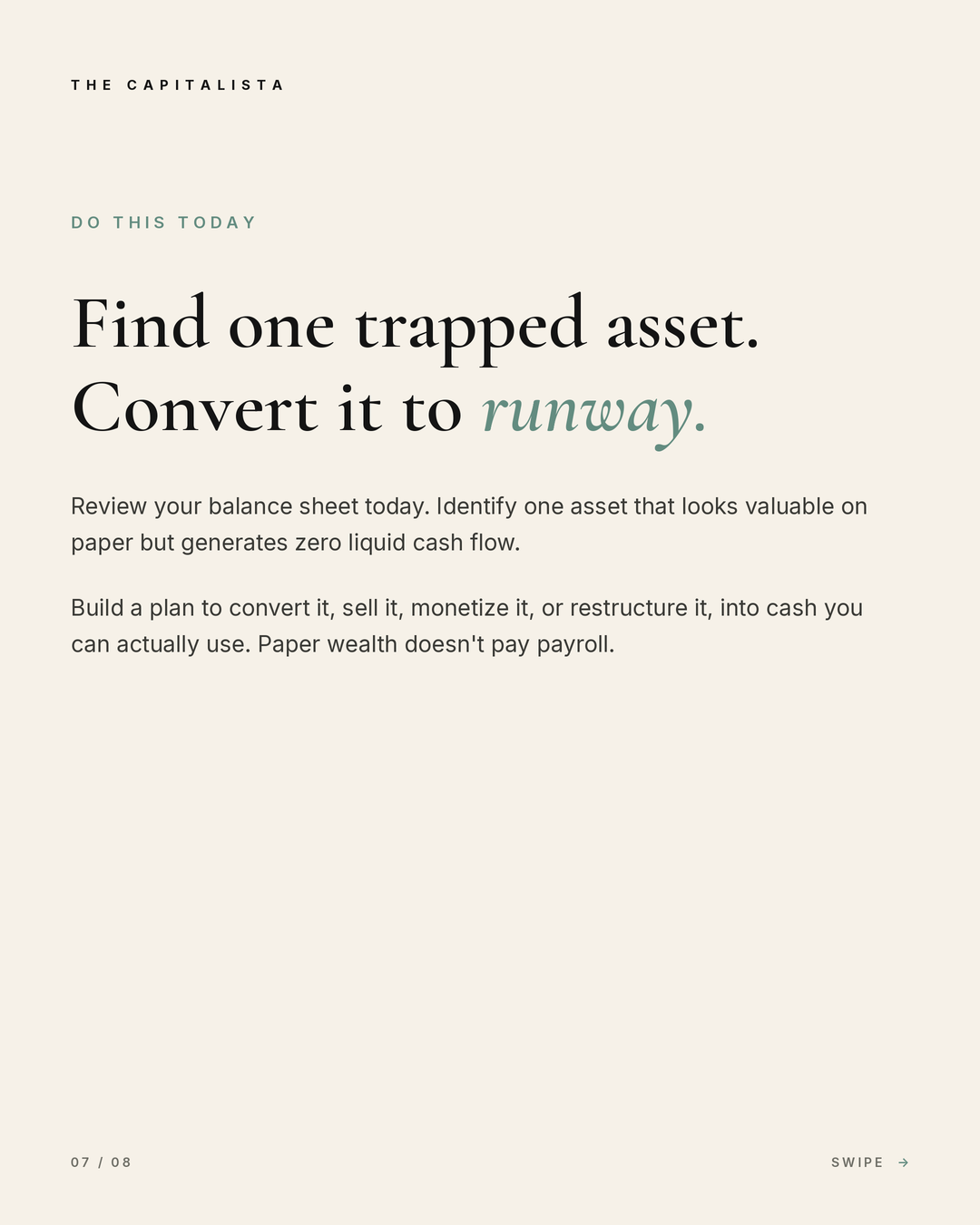
Identify one specific asset that looks valuable on paper but generates zero liquid cash flow. This might be equity in another entity, real estate, intellectual property, or any holding that's real and valuable but not currently convertible into cash you can use.
3. Build a plan to convert it
Once you've identified a trapped asset, build an actual plan to convert it into usable capital: sell it, monetize it, license it, restructure the terms around it, or find some other path to liquidity. An asset that stays permanently trapped provides exactly the same operational value Midas's gold provided him at the dinner table.
4. Track liquidity as its own metric, not a footnote to valuation
Valuation should never be the only number your leadership team tracks as a proxy for financial health. Track usable runway, actual cash position, and time-to-liquidity for your major assets as distinct, monitored metrics, not an afterthought to a more exciting valuation headline.
5. Resist the pull of paper wealth as validation
The emotional pull of a high valuation is powerful, the same way the golden touch felt like an unambiguous blessing to Midas in the first moment he received it. Build the discipline to ask, every time your company's paper value grows, whether your actual usable liquidity grew alongside it, or whether the gap between the two just got a little wider.
What The Capitalista Does
Most founders can tell you their company's valuation instantly. Far fewer can tell you, with the same confidence, exactly how much usable, liquid runway they actually have if a specific illiquid asset needed to convert to cash tomorrow.
The Capitalista is a fractional CFO service built to close exactly that gap. We:
- Audit your balance sheet for trapped, illiquid assets that look valuable on paper but generate zero usable cash flow
- Build liquidity strategies to convert paper wealth into runway before a cash crunch forces the decision on unfavorable terms
- Track your real, usable financial position as a distinct metric from valuation, so the two numbers never quietly drift apart without your knowledge
- Model what happens if you needed liquidity immediately, so you're never caught in a Midas moment with no way to convert what you own into what you need
- Help you make capital allocation decisions that protect operational liquidity, not just headline valuation
Midas didn't need more gold. He needed a way to convert what he already had into something he could actually use. Most founders chasing valuation over cash flow are standing at the exact same table, just with a much less obvious version of the same problem.
Frequently Asked Questions
What is the business lesson from the King Midas myth?
The lesson is that paper wealth and usable, liquid capital are not the same thing, and confusing them can starve a business even while it appears wealthy from the outside. Midas had unlimited wealth in gold and zero ability to use it for his most basic needs, a direct parallel to founders who chase high valuations while neglecting actual cash flow and liquidity.
Why is valuation described as a "vanity metric" in this context?
Not because valuation is meaningless, but because a high valuation doesn't automatically translate into usable cash. A company can carry an impressive valuation and still be unable to cover payroll or operating expenses if its actual liquid capital doesn't match the story the valuation tells.
What does a "trapped asset" look like in a real business?
Trapped assets can include illiquid equity stakes, unrealized valuation gains, long-term contracts, intellectual property that isn't currently monetized, or receivables tied up in slow payment cycles. These are genuinely valuable but don't provide usable cash when a business actually needs it.
How do I know if my company has a Midas problem?
If your company's valuation or balance sheet looks strong but you'd struggle to answer, with confidence, exactly how much usable runway you have if a major illiquid asset needed to convert to cash quickly, that's a strong signal the gap between paper wealth and usable wealth needs closer attention.
What's the first step to fixing a liquidity gap like this?
Separate your paper wealth from your usable wealth explicitly, identify one specific trapped asset on your balance sheet, and build an actual plan to convert it into cash you can use. Then start tracking liquidity as its own metric, distinct from valuation, going forward.
The Bottom Line
King Midas got exactly what he wished for, and it nearly destroyed him, not because gold lacked value, but because none of that value was usable in the moments he needed it most. Real wealth was never the gold itself. It was what he could actually spend.
Founders chase valuation constantly, and forget cash just as often. Both are understandable. Neither protects a business from the exact fate Midas discovered at his own dinner table: total wealth on paper, and total starvation in practice.
What's the trapped asset on your balance sheet right now that looks valuable but generates nothing you can actually use? And what would it take to convert it before it starves you the way Midas's gold starved him?