
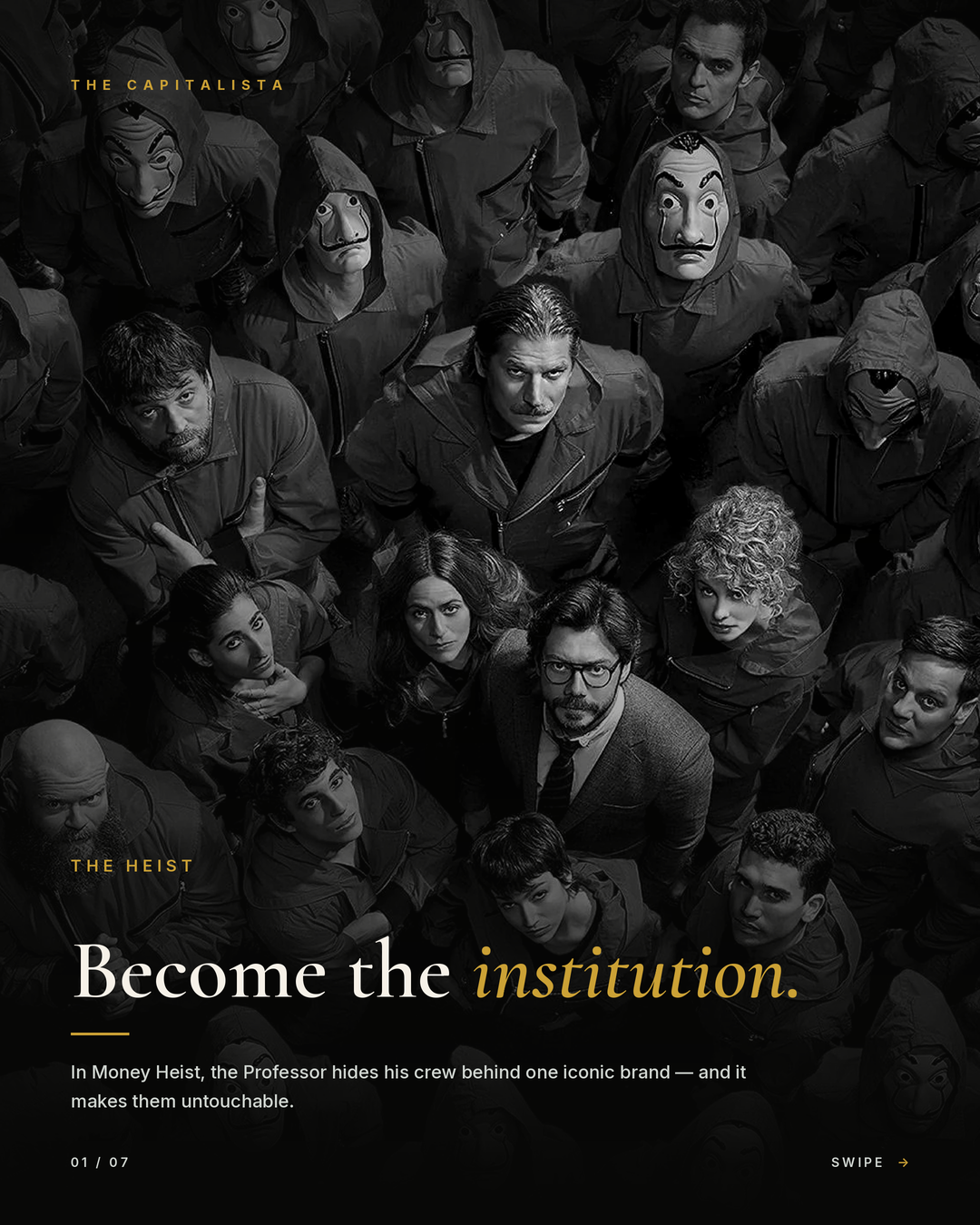
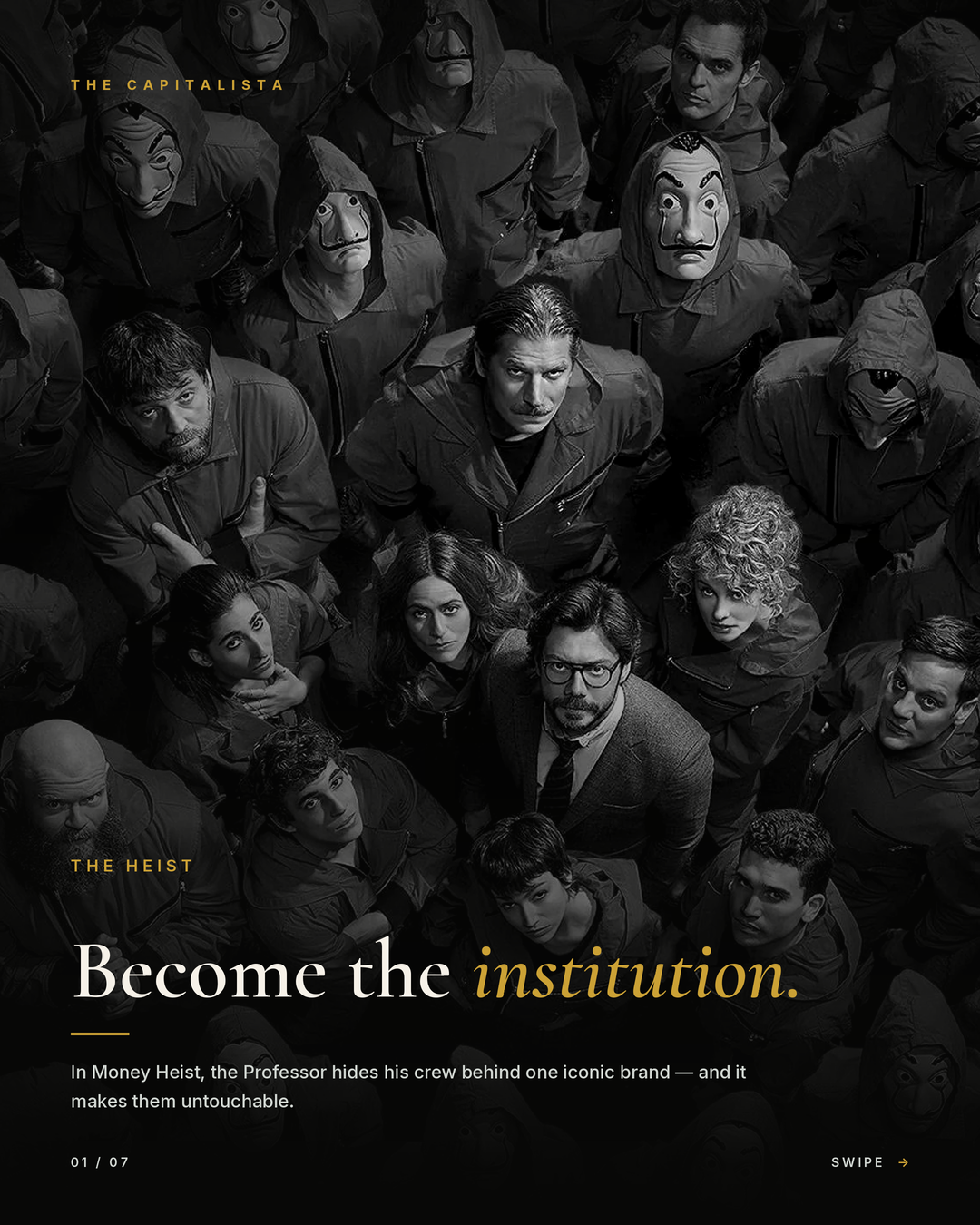
Eight people walk into the Royal Mint of Spain.
The world doesn't remember eight faces. It remembers one image: a red jumpsuit and a Salvador Dalí mask.
That's not an accident. It's the most important strategic decision in Money Heist (La Casa de Papel) — and it happens to be the single best branding lesson a founder, consultant, or service provider can learn.
The Professor, the show's mastermind, refuses to let his crew operate as individuals. No real names. No personal clothes. He forces them into city aliases — Tokyo, Berlin, Denver, Nairobi — and identical uniforms and masks. He deliberately erases their identities and welds them into one iconic symbol.
This post breaks down what the mask and jumpsuit actually mean, why erasing the individual was a stroke of genius, and how to apply the same principle to stop capping your business at the size of your own name.
What the Dalí Mask and Red Jumpsuit Really Mean
If you haven't seen the show, here's the setup: a group of robbers, coordinated by a planner called The Professor, occupy the Royal Mint of Spain. They wear matching red jumpsuits and masks of the Spanish surrealist artist Salvador Dalí, and they go by the names of cities instead of their own.
The costumes aren't just for anonymity. They carry deliberate meaning:
- The red jumpsuit signals passion, blood, and resistance — and red is one of Spain's national colors, long associated with anti-establishment movements.
- The Dalí mask invokes a Spanish artist whose surrealist work was itself a form of defiance. The Professor describes his motivation as "resistance and indignation" toward the capitalist system.
Together, the uniform elevates the story from a crime into a movement. And here's the proof it worked: the red-jumpsuit-and-Dalí-mask look has since appeared at real protests in Iraq, Lebanon, France, and Chile. A costume from a Netflix show became a portable, global symbol of resistance — long after any individual character mattered.
That is what a real brand does. It outlives the people inside it.
The Professor's Real Genius: Erasing the Individual
Most people watch Money Heist and see clever robberies. The deeper move is what the Professor does to his own team before the heist even starts: he strips them of individuality on purpose.
Why would a leader erase the identities of his best operators? Because individuality is a liability when you're trying to build something bigger than any one person. As long as the crew are eight distinct people, the police can profile them, the public can judge them, and any single arrest unravels the whole thing.
Turn them into one uniform symbol, and everything changes. The strategy becomes unassailable. The identity becomes iconic. And the individuals are shielded behind a collective that's far more powerful than the sum of its parts.
Why the Uniform Works
The mask does three jobs at once, and each one has a direct business parallel:
- It scrambles the opposition. Police can't target a person they can't identify. A competitor can't easily attack or copy a brand that isn't reducible to one founder's name.
- It wins the crowd. A movement earns sympathy and authority a lone criminal never could. An institution commands trust and premium pricing a solo freelancer struggles to reach.
- It shields the operators. Behind the collective, the individuals get privacy and protection. Behind a business brand, you protect your personal time, liability, and reputation.
Anonymity, in this frame, isn't hiding. It's leverage.
The Business Lesson: Stop Selling Yourself, Build an Institution
Here's where the show stops being entertainment and starts being a mirror.
Most advanced operators market their high-ticket consulting or specialized services under their own individual name, as a solo freelancer. It feels natural — you are the expertise. But it quietly places a hard ceiling on the entire enterprise.
When you sell "yourself," three things happen:
- Your pricing anchors to your personal hours. You can only bill so many, so your revenue has a mathematical cap.
- You carry all the liability. Every deliverable, every outcome, every risk lands on one person — you.
- The business can't exist without you in the room. That's not a company. That's a job you can't quit.
The Professor's move is the antidote: shift from the individual to the institution. Stop selling you, and start wrapping your frameworks, digital assets, and delivery team inside a unified, institutional brand backed by repeatable operational blueprints.
When your business is positioned as an elite system rather than a person, you transition from freelance contractor to structural powerhouse. You command corporate-level fees. You scale delivery beyond your own hours. And you protect your time and privacy — because the brand, not your name, is doing the work.
The Solo Ceiling: Why a Personal Brand Caps You
A personal brand is fantastic for attention and terrible for enterprise value. If 85% of your business lives inside one person — their hours, their judgment, their relationships — then 85% of the value walks out the door the moment that person is unavailable. Buyers know this, which is why solo operators rarely command institutional pricing.
An institution spreads the value across systems, a team, and a brand. That's what makes it durable, sellable, and expensive. The red jumpsuit didn't need any single robber. Your business shouldn't need any single you.
How to Turn Your Name Into an Institution
You don't have to disappear behind a mask. You have to build a system that stands on its own. Here's how.
1. Name and package your method
Take your best framework and give it a proprietary name and a documented, repeatable blueprint — something that produces results without you personally running every step.
2. Sell the brand, not the founder
Reposition your delivery under one institutional brand rather than your personal profile. The method is the product; you are the founder, not the deliverable.
3. Build a team and a system around delivery
Institutions scale because the work doesn't depend on one person. Document your process so others can execute it to your standard.
4. Fix the financial engine underneath
This is the part most "personal brands" skip — and it's where the ceiling actually lives. An institution is defined by its numbers: margins that support a team, cash flow that survives a slow month, pricing that reflects a system rather than an hourly rate. Without financial structure, you have a nicer logo on the same fragile solo business.
What The Capitalista Does
That last point is exactly where The Capitalista comes in.
The Capitalista is a fractional CFO service for founders and service businesses making the shift from solo operator to institution. In plain terms, we become the financial command behind your brand — the part of an institution that a personal brand almost always lacks.
Concretely, that means we:
- Own your margins and pricing — so your fees reflect a system's value, not an hourly rate, and every engagement is actually profitable.
- Run your cash flow and forecasting — so you can hire, delegate, and scale delivery without gambling the business on a slow quarter.
- Build the financial blueprint — the repeatable numbers, dashboards, and decision rules that let the business run without you personally holding it all in your head.
- Translate the finances into plain-English decisions — what to charge, what to cut, what to invest in next, and when.
A logo and a name make you look like an institution. The financials are what make you one. The Capitalista supplies the CFO-level structure that turns a talented solo operator into a business that prices, scales, and endures like a firm.
Frequently Asked Questions
Why do the robbers wear Dalí masks in Money Heist?
The Salvador Dalí mask references a famous Spanish surrealist artist whose work symbolized resistance. In the show it represents defiance of the establishment while hiding the robbers' identities — turning the crew into an anonymous, iconic movement.
What do the red jumpsuits symbolize?
Red signals passion, blood, and resistance, and is a Spanish national color long tied to anti-establishment movements. The matching jumpsuits also strip away individuality, uniting the crew into a single recognizable symbol.
What's the difference between a personal brand and an institutional brand?
A personal brand sells one individual's name, time, and reputation — which caps pricing and creates dependency. An institutional brand sells a system: named methods, a team, and repeatable delivery that scales beyond any one person and commands higher fees.
Should I build a personal brand or a business brand?
Use a personal brand for attention, but build an institution for value. Attention can start with your name; durable, sellable enterprise value comes from systems, a team, and financial structure that don't depend on you.
What is a fractional CFO?
A fractional CFO is an experienced finance leader who runs your margins, cash flow, pricing, and financial strategy part-time — giving a growing business CFO-level command without the full-time cost. It's the financial backbone that turns a solo service into an institution.
The Bottom Line
Money Heist dressed eight people in one uniform and created a symbol powerful enough to appear at protests around the world. The individuals were forgettable. The institution was unforgettable.
Your business faces the same choice. Sell yourself, and you're capped at your own hours and name. Build the institution — the system, the team, and the financial structure underneath — and you become something far bigger than any one person. Stop selling yourself. Build the brand that outlasts you.
.png)
.png)
.png)
.png)
.png)
.png)