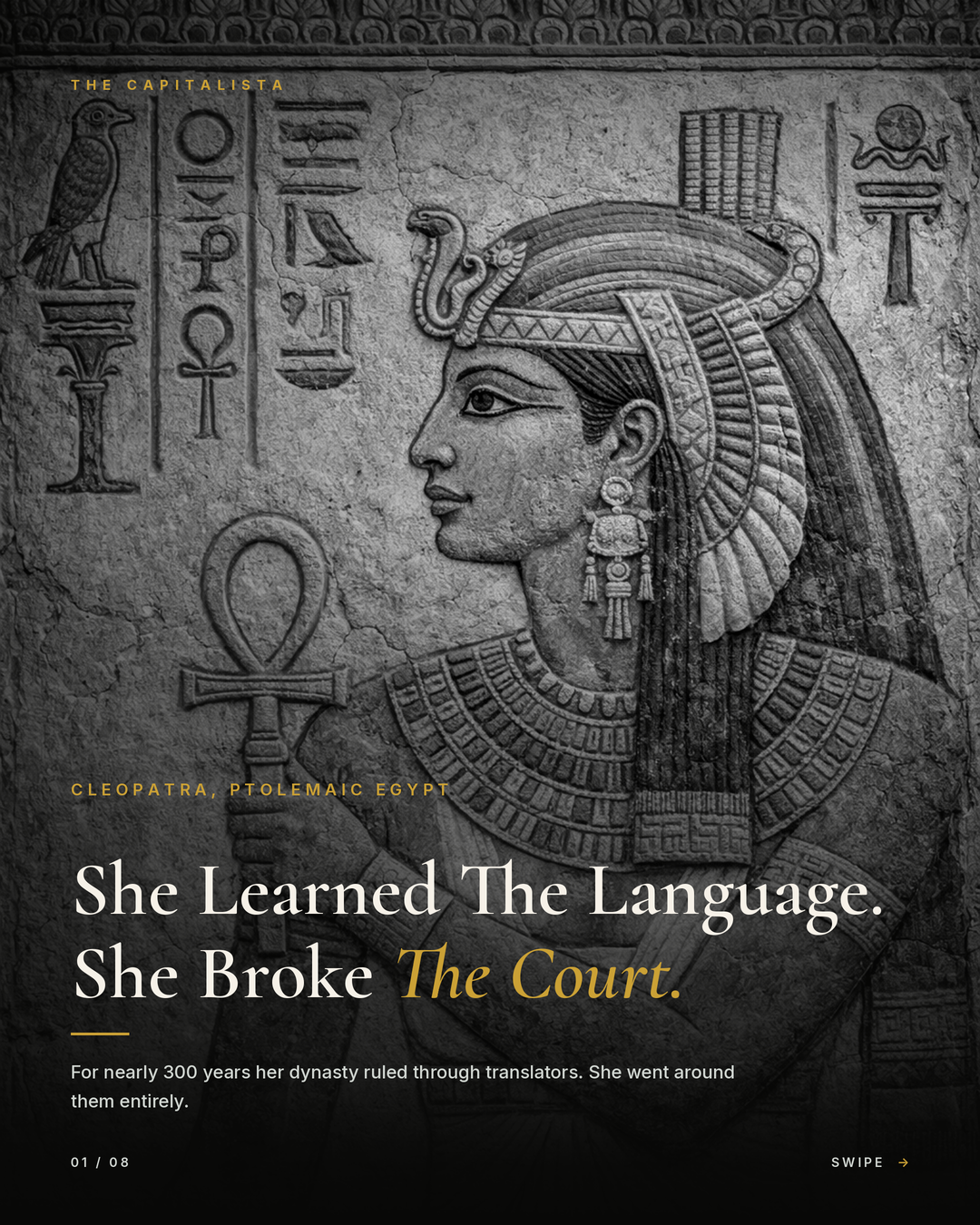
For nearly three hundred years, Cleopatra's family ruled Egypt without ever fully belonging to it.
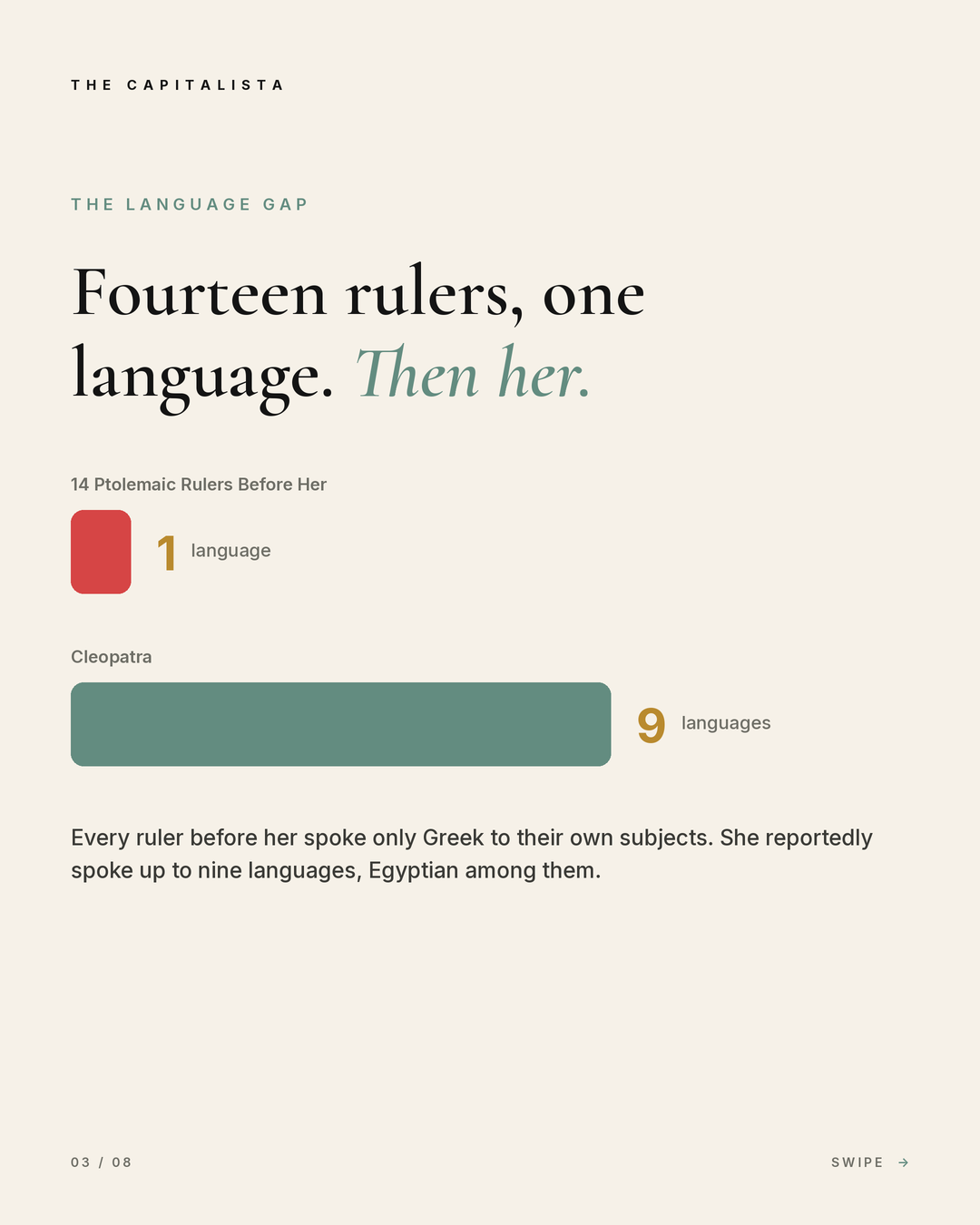
The Ptolemaic dynasty was Greek by origin, and every ruler before her maintained that separation deliberately, speaking only Greek to their own subjects for generation after generation. Fourteen rulers. One language. Total dependence on translators and court intermediaries to reach the very people they governed.
Cleopatra broke that pattern entirely. She became the first ruler in her dynasty's history to learn Egyptian, and by most historical accounts, she went much further than that, reportedly speaking up to nine languages in total. She didn't just add a skill to her resume. She dismantled three centuries of inherited distance between her family and the people they ruled.
The result wasn't a cultural footnote. It fundamentally changed how she governed. By speaking directly to her people instead of through a chain of court translators and intermediaries, she built a form of influence her predecessors, isolated behind generations of linguistic and cultural distance, never had access to.
This is a story about language, but the underlying lesson has almost nothing to do with linguistics. It's about what happens to your influence, your narrative, and your relationships the moment you let someone else stand permanently between you and the people who matter most to your success.
The Isolation Built Into the System
It's worth understanding just how deliberately isolated Cleopatra's predecessors were, because the isolation wasn't an accident or an oversight. It was, in effect, the operating model.
Ruling through intermediaries came with real advantages from a certain perspective. It maintained a clear separation between the ruling class and the ruled. It required less personal investment in understanding the culture and concerns of ordinary Egyptians. It let the Ptolemaic court operate largely on its own terms, insulated from direct engagement with the population's actual conditions and grievances.
But that insulation came at an enormous, mostly invisible cost. Every piece of information flowing between the ruler and the ruled passed through an intermediary, a translator or court official, who inevitably shaped, filtered, and interpreted it along the way. The ruler never heard concerns directly. The people never heard their ruler's intentions directly. Both sides experienced each other only through a layer of interpretation neither of them controlled.
What Changed When She Removed the Layer
When Cleopatra learned Egyptian and began engaging directly with her subjects, she didn't just gain a practical convenience. She removed an entire layer of interpretation that had defined, and limited, every ruler before her.
This mattered because whoever controls the translation controls the narrative. A court intermediary, however well-intentioned, inevitably makes choices, what to emphasize, what to soften, what to leave out, that shape how a message lands. Over three hundred years, that filtering compounded into a genuine, structural distance between the Ptolemaic rulers and the Egyptian people they governed.
By speaking directly, Cleopatra collapsed that distance. She could deliver her own message, in her own words, with her own emphasis, directly to the people she needed to influence. She could also hear, without filtering, what her people actually wanted and feared, information her predecessors had access to only through whatever their intermediaries chose to pass along. Direct communication didn't just improve her image. It gave her a fundamentally more accurate picture of the situation she was governing, and a fundamentally more powerful ability to shape how she was perceived within it.
The Modern Trap: Intermediaries That Feel Efficient
Almost no modern founder or executive would consciously choose to isolate themselves from their customers or their market the way the Ptolemaic dynasty did for three centuries. But most businesses build exactly that isolation anyway, one seemingly reasonable delegation decision at a time.
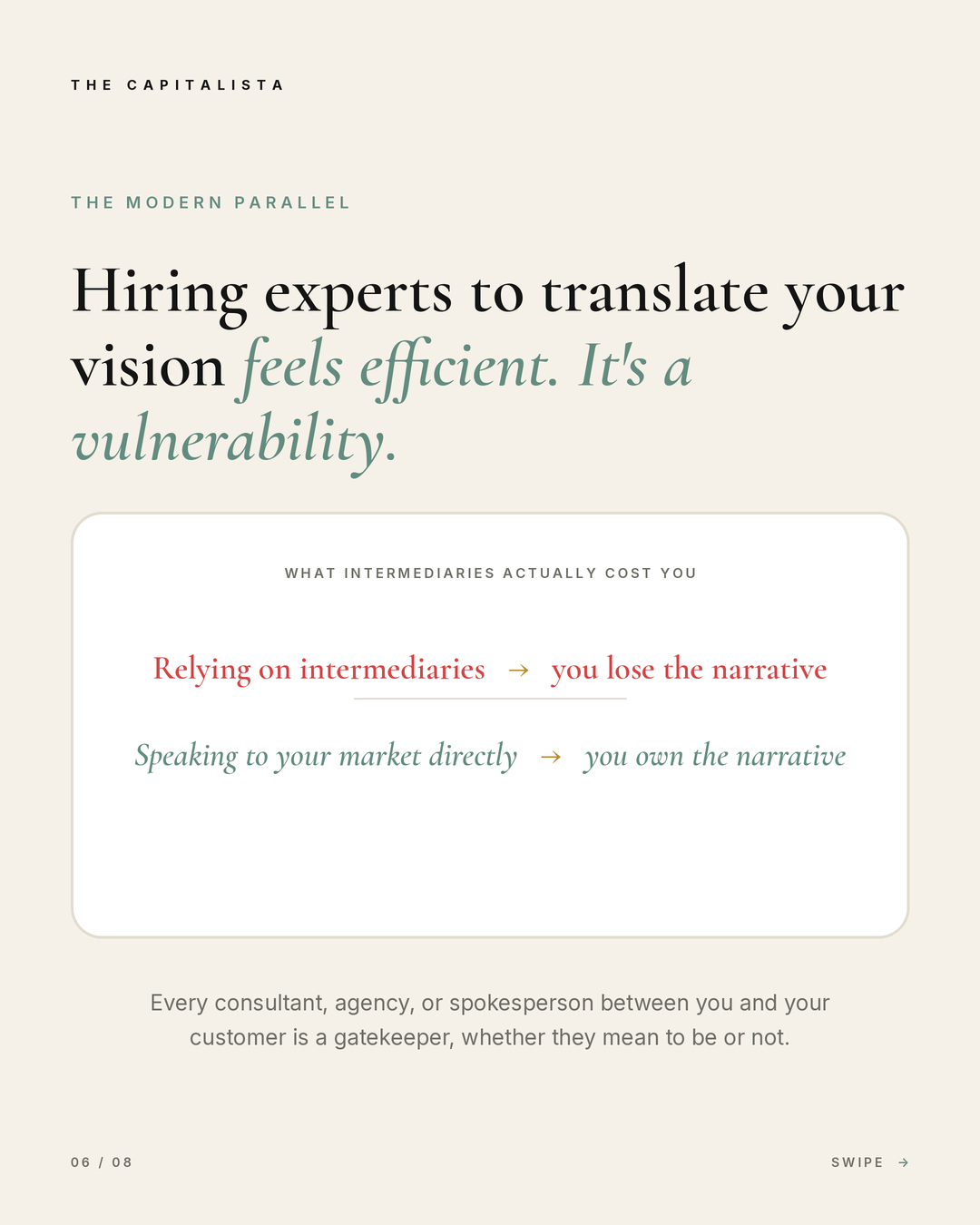
Hiring a PR firm to manage your public communications feels efficient. Using an agency to handle your customer-facing marketing feels efficient. Letting a sales team or a spokesperson be the only voice your market ever hears feels efficient. Every one of these decisions is individually reasonable, often even necessary at scale. But collectively, they can quietly recreate the exact structure that isolated Cleopatra's predecessors: a permanent layer of interpretation standing between you and the people whose perception of you actually determines your success.
The uncomfortable truth is that every consultant, agency, or spokesperson positioned between you and your customer is a gatekeeper, whether or not they intend to be. They make interpretive choices on your behalf, constantly, about what your message actually is. Most of the time you never even see those choices being made.
Why This Costs More Than It Appears To
The cost of relying entirely on intermediaries rarely shows up as an obvious, single failure. It shows up as a slow, compounding loss of narrative control that's difficult to notice until it's already significant.
When you rely on intermediaries for your customer or market-facing communication, you lose the ability to correct a misunderstanding in real time, because you're not the one having the conversation. You lose the nuance in your own message, because someone else is deciding which parts to emphasize and which to soften. You lose direct access to the unfiltered feedback that would tell you your message isn't landing the way you think it is, because that feedback gets filtered, summarized, or lost entirely somewhere between your customer and you.
Over time, this produces a strange and dangerous outcome: a founder or executive who is confident about how their business is perceived, based entirely on secondhand, filtered information, while the actual perception in the market has drifted somewhere else entirely. This is precisely the isolation the Ptolemaic dynasty experienced for three centuries, just wearing a modern, more efficient-looking costume.
Speaking Directly Doesn't Mean Doing Everything Yourself
It's worth being precise about what this lesson does and doesn't require, because taken too literally it becomes impractical advice. You don't need to personally answer every customer email or handle every piece of market communication yourself. Cleopatra still had a court, still had officials, still delegated enormous amounts of governance.
What she refused to delegate entirely was the direct relationship itself: the ability to speak, unfiltered, to the people whose perception of her mattered most, at the moments when it mattered most. The lesson isn't "never delegate." It's "never let delegation become total, permanent distance between you and the relationships that determine your success."
The most effective founders and executives apply this same distinction. They build teams, agencies, and processes to handle scale. But they preserve direct, unfiltered access to their most important customer relationships, their market's honest feedback, and the moments where their own voice, not an intermediary's interpretation of it, is what actually needs to be heard.
How to Apply This to Your Own Business
1. Map every intermediary currently standing between you and your market
List every agency, spokesperson, sales layer, or communications process that currently sits between your actual voice and the people you most need to reach and understand. Most founders have never actually mapped this out, and doing so is often the first moment the scale of the isolation becomes visible.
2. Identify which relationships are too important to fully delegate
Not every customer touchpoint needs your direct involvement. But some do: your most important accounts, your most public moments, the situations where a misunderstanding would be most costly. Identify those specifically, and make sure you have a direct, unfiltered channel into them.
3. Build in a mechanism for unfiltered feedback
Even where you delegate communication, build a parallel channel that lets you hear, directly and without interpretation, what your market actually thinks. This might be as simple as personally reading a sample of raw customer feedback rather than only reading a summarized report.
4. Bypass one gatekeeper this week
You don't need to overhaul your entire communication structure at once. Identify one gatekeeper currently controlling a piece of your message today, and go around them, even just once, to directly deliver your own version of that message. Notice what changes.
5. Reserve your own voice for the moments that matter most
You can't personally handle everything at scale, and you shouldn't try. But reserve your direct, personal voice, not a spokesperson's interpretation of it, for the relationships and moments where controlling your own narrative matters most.
What The Capitalista Does
Most founders unknowingly outsource their financial narrative the same way Cleopatra's predecessors outsourced their political one: through accountants, advisors, and reports that summarize and interpret the numbers rather than letting the founder understand them directly.
The Capitalista is a fractional CFO service built around the opposite principle. We:
- Translate your financial data into language you actually understand, so you're never dependent on someone else's interpretation of your own numbers
- Make sure you can speak to your own financial story directly, to investors, partners, and your team, without routing it through an intermediary
- Identify where financial gatekeeping is quietly distorting your decision-making, the same way court intermediaries distorted the truth reaching ancient rulers
- Build reporting that gives you direct, unfiltered visibility, not a summarized version someone else decided was worth showing you
- Position you to own your financial narrative with investors and stakeholders, instead of outsourcing that story to someone else's version of it
Cleopatra understood that whoever controls the translation controls the narrative. That principle applies just as directly to your finances as it did to a nearly three-hundred-year-old dynasty's relationship with the people it governed.
Frequently Asked Questions
What is the business lesson from Cleopatra learning multiple languages?
The lesson is that direct communication with the people who matter most to your success, customers, employees, investors, is a source of real influence that gets lost the moment you rely entirely on intermediaries. Cleopatra bypassed centuries of inherited distance between her dynasty and its subjects by learning to speak to them directly.
Why is relying on intermediaries risky for a business?
Every intermediary, whether an agency, spokesperson, or consultant, makes interpretive choices about your message that you don't fully control and often never see. Over time, this can create a gap between how you believe your business is perceived and how it's actually perceived, without any single visible failure point.
Does this mean founders should never delegate communication?
No. The lesson isn't to avoid delegation entirely, it's to avoid letting delegation become total, permanent distance from the relationships that matter most. Reserve direct, unfiltered communication for your most important customers, your most public moments, and situations where misunderstanding would be most costly.
How do I know if I've lost control of my own narrative?
A common sign is confidently believing you know how your business is perceived, based entirely on secondhand or summarized information, without having direct, unfiltered contact with your market recently. If you can't remember the last time you heard raw, unfiltered feedback, that's worth investigating.
What's a simple first step to regaining direct control of my narrative?
Identify one gatekeeper, an agency, a spokesperson, a layer of reporting, currently controlling a piece of your message or your financial understanding, and bypass them once this week to get the unfiltered version directly. Notice what you learn that you wouldn't have otherwise.
The Bottom Line
Fourteen rulers before Cleopatra accepted the same inherited distance from their own people, generation after generation, because it was the way things had always been done. She rejected that inheritance and learned to speak directly to the people whose perception of her would determine everything.
Every consultant, agency, or spokesperson between you and the people who matter most to your business is a gatekeeper, whether they mean to be or not. Direct communication is the only way to fully own your own narrative, and that lesson hasn't changed in over two thousand years.
Who is currently standing between you and the people you most need to hear from, or be heard by, directly? And what would it change if you spoke to them yourself instead?