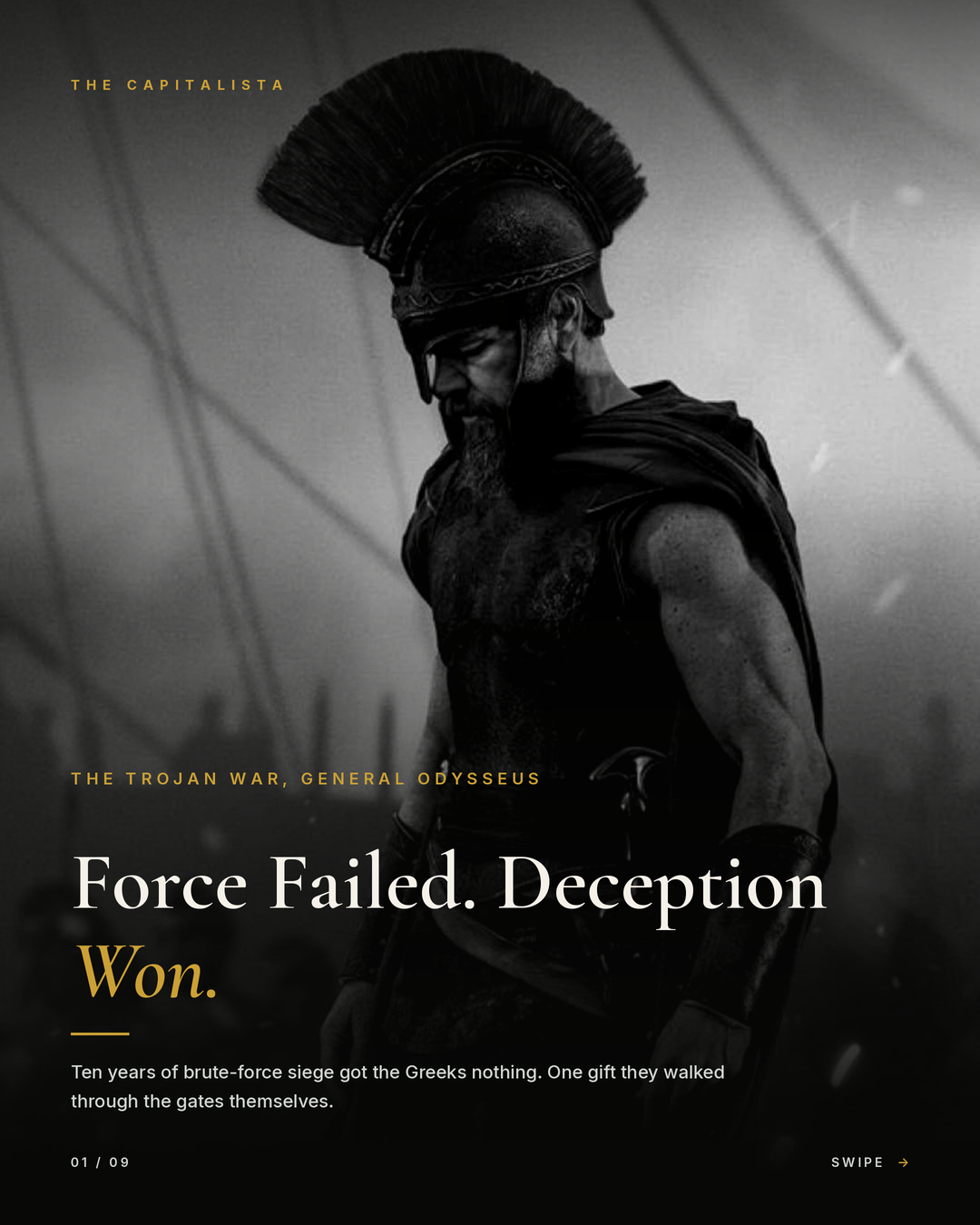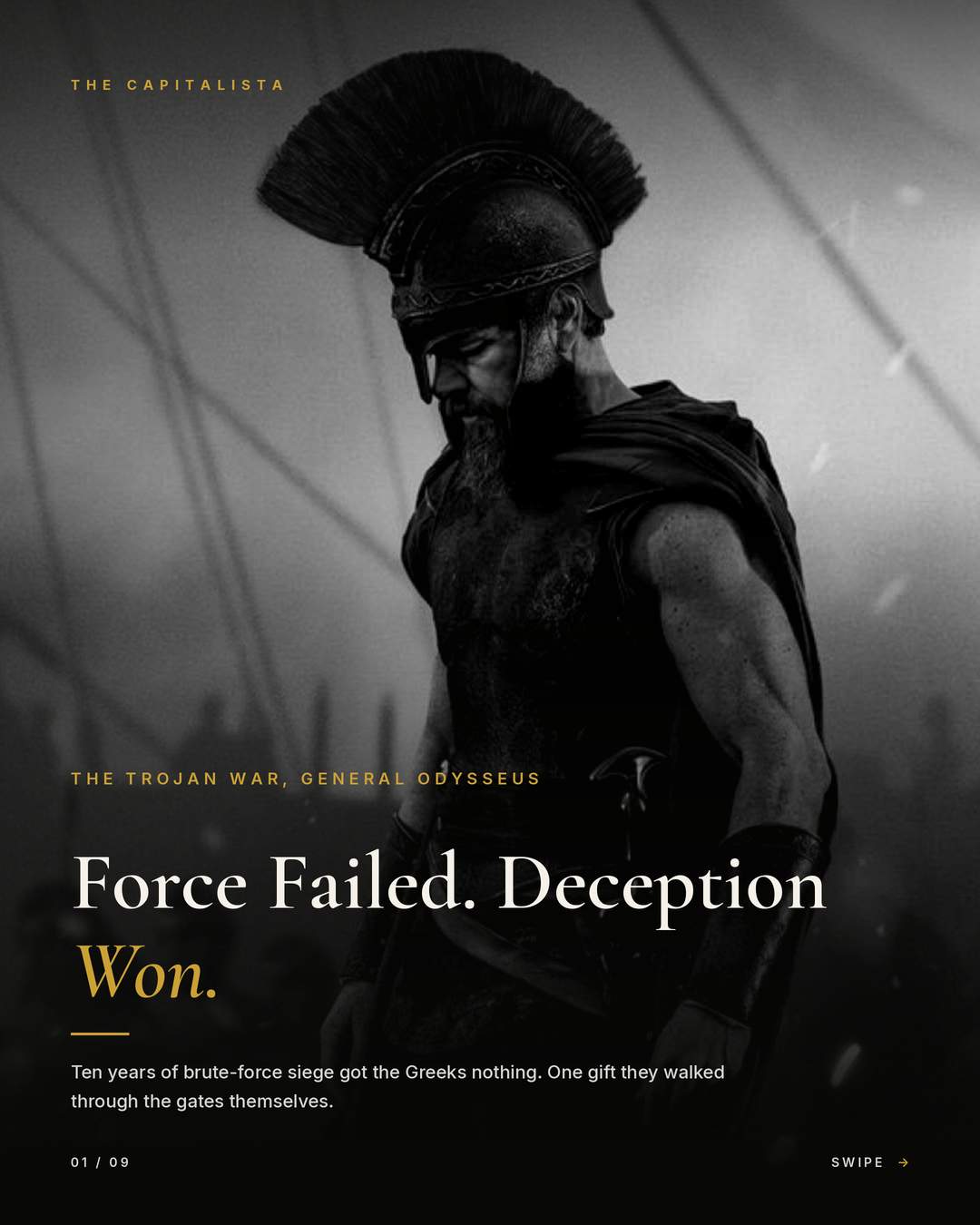
For ten years, the Greek army camped outside the walls of Troy and did the only thing armies knew how to do: attack.
Direct assault after direct assault. Ladders against stone. Spears against gates. Every tactic force could offer, thrown at the same immovable wall, for a decade.
The walls held every single time.
Then General Odysseus stopped attacking the wall entirely. He built a giant wooden horse, a prestigious, valuable-looking gift, and left it outside the gates. The Trojans didn't just fail to stop it. They dragged it through their own gates themselves, celebrating as they did it.
The war that ten years of brute force couldn't win ended in a single night, because someone finally understood that the wall was never the actual obstacle.
This is one of the oldest stories in Western literature, and it contains one of the most consistently ignored lessons in modern business: you cannot force your way through a defended gate. You can only build something the people behind it want badly enough to open it themselves.
The Trap of Believing Harder Force Is the Answer
The Greeks' decade-long siege wasn't a failure of effort. It was a failure of premise. Every year the direct assault failed, the instinctive response wasn't to question the strategy, it was to attack harder, longer, with more resources thrown at the same broken approach.
This is exactly the trap most businesses fall into with outbound sales and marketing. The pitch isn't landing, so the answer becomes more cold calls, more emails, more ad spend, more aggressive follow-up sequences. The volume goes up. The fundamental approach, forcing your way past a defended gate, never gets questioned.
Modern buyers have spent years building exactly the kind of defenses Troy had. They've been pitched to relentlessly by every vendor in their inbox. They've developed institutional immune systems against direct, self-interested sales approaches. The gate isn't undefended anymore. It's reinforced by a decade of exactly the kind of siege tactics still being thrown at it.
What Odysseus Actually Understood
The brilliance of the Trojan Horse wasn't the woodworking. It was the psychological insight underneath it: Troy didn't need to be broken into. Troy needed to be given a reason to open its own gates.
Odysseus didn't build a weapon. He built something the Trojans genuinely wanted inside their own walls: a valuable, prestigious trophy that looked like proof of their own victory. He understood that the fastest way through a defended gate isn't more force against it. It's removing the reason the gate needs to stay defended in the first place.
This is the exact mechanism that separates businesses that struggle to get past gatekeepers from businesses that get pulled through the gate by the buyer themselves. The horse wasn't a trick used to sneak past defenses. It was something genuinely valuable enough that the defenders chose to bring it inside voluntarily.
Why This Matters More Now Than It Did a Decade Ago
Buyer behavior has fundamentally shifted, and most outbound sales and marketing strategy hasn't caught up.
A decade ago, direct outbound worked reasonably well because buyers had fewer defenses and fewer alternatives. A well-timed cold call or a persuasive email could still break through, because the wall wasn't fully built yet.
That's no longer true. Buyers today are inundated with hundreds of pitches a month across every channel. They've built spam filters, gatekeepers, procurement processes, and simple learned skepticism specifically to defend against exactly the kind of direct-assault selling that used to work. The wall isn't just standing. It's actively being reinforced by every aggressive pitch that hits it and bounces off.
Meanwhile, buyers are more willing than ever to seek out and invite in resources that are genuinely useful to them. Free tools, real diagnostics, substantive content that solves an actual problem, these get welcomed through the gate voluntarily, at the exact moment the buyer decides they're ready. The asymmetry has never been starker: force is harder than ever, and invitation is easier than ever, and most businesses are still optimizing for the wrong one.
The Two Paths Through the Wall
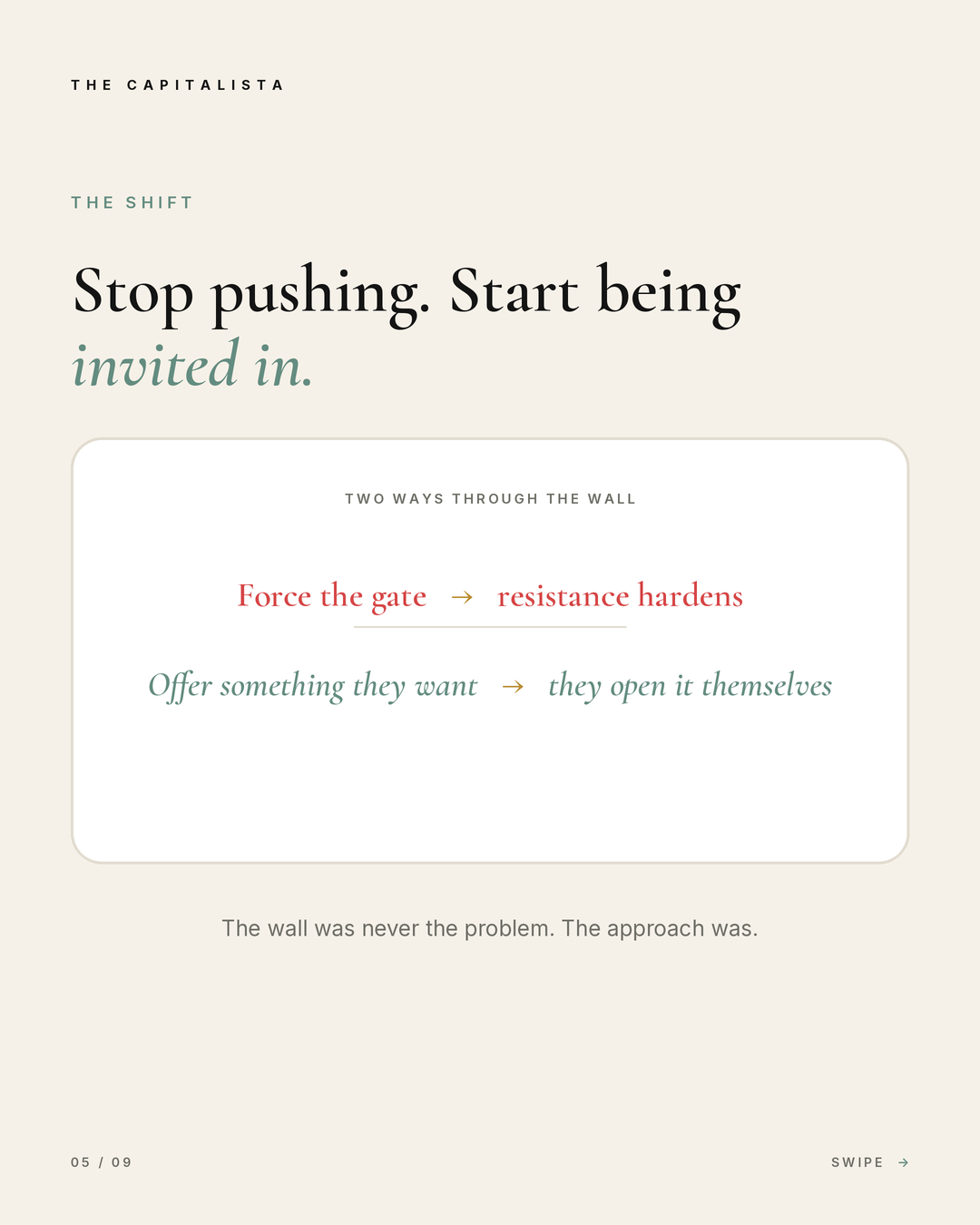
There are only two ways past a defended gate, and understanding the difference between them changes how you should be building your entire sales and marketing motion.
The first path is forcing the gate. You push a direct pitch at a prospect who hasn't asked for it, hoping volume or persistence eventually wears down the resistance. This path gets harder every year, because every pitch that lands and gets rejected reinforces the defenses a little more. Resistance doesn't just stay constant under this approach. It hardens.
The second path is offering something they want badly enough to open the gate themselves. You build something genuinely valuable, a tool, a diagnostic, an insight, that the prospect wants inside their world regardless of whether they're ready to buy anything yet. This path gets easier the more genuinely useful the offering is, because the prospect is doing the work of inviting you in rather than resisting your attempt to force your way through.
Every sales and marketing decision your business makes falls into one of these two categories. Most businesses default to the first path because it feels more direct and more controllable. The businesses that actually win the account are usually running the second strategy.
What the Modern Trojan Horse Actually Looks Like
The modern equivalent of the wooden horse isn't a trick or a disguised pitch. It's a genuinely valuable asset built specifically to be worth inviting inside a prospect's world before any sales conversation happens.
This could be a free diagnostic tool that gives a prospect real, specific insight into their own business, something they couldn't easily get elsewhere. It could be a piece of proprietary research or benchmark data relevant to their exact situation. It could be a working sample of the value you provide, delivered with no strings attached, that's substantive enough to be worth their time on its own merits.
The critical distinction is this: a disguised pitch dressed up as a free resource is not a Trojan Horse. Buyers today can smell that instantly, and it does more damage to trust than an openly direct pitch would have. The horse only works because the Trojans genuinely believed, correctly, that it was valuable on its own terms. The moment your "free tool" is obviously just a lead-generation trick, you've rebuilt the wall you were trying to get past.
How to Build Your Own Trojan Horse
1. Identify what your prospect actually wants inside their walls right now
Not what you want to sell them. What they're actively trying to solve for themselves, right now, independent of whether they ever become your customer. This requires genuinely understanding their problem, not just your product.
2. Build something valuable enough to stand on its own
The asset needs to deliver real value even if the prospect never buys anything from you. If it only has value as a lead-in to a sales pitch, it's not a horse, it's just a disguised battering ram, and modern buyers will recognize the difference immediately.
3. Make it specific, not generic
A generic industry whitepaper gets ignored. A diagnostic tool that analyzes their specific numbers, their specific situation, their specific gap, gets opened. Specificity is what makes something worth dragging through the gate. Generic content just looks like more siege equipment.
4. Let them invite it in on their own timeline
The horse sat outside the gates. The Trojans decided when and whether to bring it in. Resist the urge to force urgency or manufacture false scarcity around your free asset. The entire mechanism depends on the invitation coming from the prospect's own decision, not your pressure.
5. Be ready when they open the gate
Once a prospect engages with something genuinely valuable you've built, they're no longer defending against you. That's the moment the actual relationship starts. Make sure what happens next lives up to the value of what got you invited in.
The Risk of Getting This Wrong
It's worth being honest about how this strategy fails. If your "valuable asset" turns out to be thin, generic, or transparently designed only to capture contact information, you don't just fail to build trust, you actively damage it. A fake horse is worse than an honest, direct pitch, because it signals manipulation rather than confidence.
This strategy only works when the value is real. That means it requires more upfront investment and more genuine expertise than simply writing another cold outreach sequence. That's exactly why most competitors won't do it properly, and exactly why it works disproportionately well for the businesses that do.
What The Capitalista Does
Most founders default to direct pitching because it feels more controllable than building something prospects genuinely want to invite in. But direct pitching gets harder every year, while genuinely valuable insight gets easier to use as a door-opener.
The Capitalista is a fractional CFO service that helps you turn your financial expertise into exactly this kind of asset. We:
- Build real diagnostic tools from your financial data that give prospects genuine, specific insight into their own numbers, not generic content dressed up as value
- Identify what your ideal prospects actually want to know about their own business right now, so what you build is specific enough to be worth their time
- Package your expertise into assets that stand on their own, so the value is real whether or not the prospect ever becomes a client
- Structure your financial storytelling so it earns trust before a single sales conversation happens
- Help you resist the instinct to force the pitch, and build the patience required for prospects to invite you in on their own timeline
The Greeks spent ten years learning that force wasn't the answer. You don't have to spend ten years learning the same lesson about your own sales strategy.
Frequently Asked Questions
What is the "Trojan Horse strategy" in business?
It refers to winning access to a prospect or account not through direct, forceful pitching, but by offering something genuinely valuable that the prospect chooses to bring into their own world voluntarily. The value has to be real, not a disguised sales pitch, for the strategy to work.
Why does aggressive outbound sales stop working over time?
Because every rejected direct pitch reinforces a prospect's defenses against future direct pitches. Buyers today have been pitched to so relentlessly that they've built institutional resistance to outbound approaches, making forceful tactics progressively less effective rather than more.
What makes a "Trojan Horse" asset different from a disguised sales pitch?
A genuine Trojan Horse asset delivers real value to the prospect even if they never buy anything. A disguised pitch only pretends to offer value while existing solely to capture a lead. Buyers can usually tell the difference, and a disguised pitch damages trust more than an honest direct approach would have.
How do I know what to build as my own "Trojan Horse"?
Start with what your ideal prospect is actively trying to solve for themselves right now, independent of your product. The most effective assets are specific to their exact situation, a diagnostic, a benchmark, a tailored analysis, not generic content that could apply to anyone.
Does this mean I should stop doing outbound sales entirely?
Not necessarily. Outbound can still play a role, particularly for initiating contact. But it shouldn't be the primary mechanism you rely on to win defended, high-value accounts. The businesses that win the hardest accounts are usually the ones the prospect invited in, not the ones that pushed hardest to get there.
The Bottom Line
The Greeks didn't win because they finally found a stronger battering ram. They won because Odysseus stopped trying to force the gate and built something Troy wanted badly enough to open it themselves.
Most businesses are still running the ten-year siege strategy: more calls, more emails, more pressure against a wall that's only getting more reinforced with every attempt. The businesses that actually win the account they want most are usually doing something quieter and harder: building something genuinely valuable enough that the prospect drags it through the gate on their own.
What's the wall you're still trying to force your way through? And what would you have to build for them to open it themselves instead?